
Svalbard is one of the planet's last great wildernesses and one of the very few places where polar bears can be photographed in their natural environment. The archipelago lies halfway between northern Norway and the North Pole, at 78° north latitude, offering a landscape of glaciers, pack ice, and barren mountain terrain that is unmatched.
For the nature photographer, Svalbard is the ultimate Arctic experience. Polar bears wander along the ice edge hunting for seals, walruses rest in colonies on beach ridges, and Arctic foxes hunt lemmings on the tundra. During the summer months, the midnight sun bathes the landscape in soft, golden light around the clock — perfect for photography at any time of day. Expedition ships take you close to wildlife with zodiac boats, and experienced guides ensure both safety and optimal photo opportunities.
Latitude
74–81° N
Polar Bears
~3 000
Glacier Coverage
60 %
Best Season
Jun–Sep
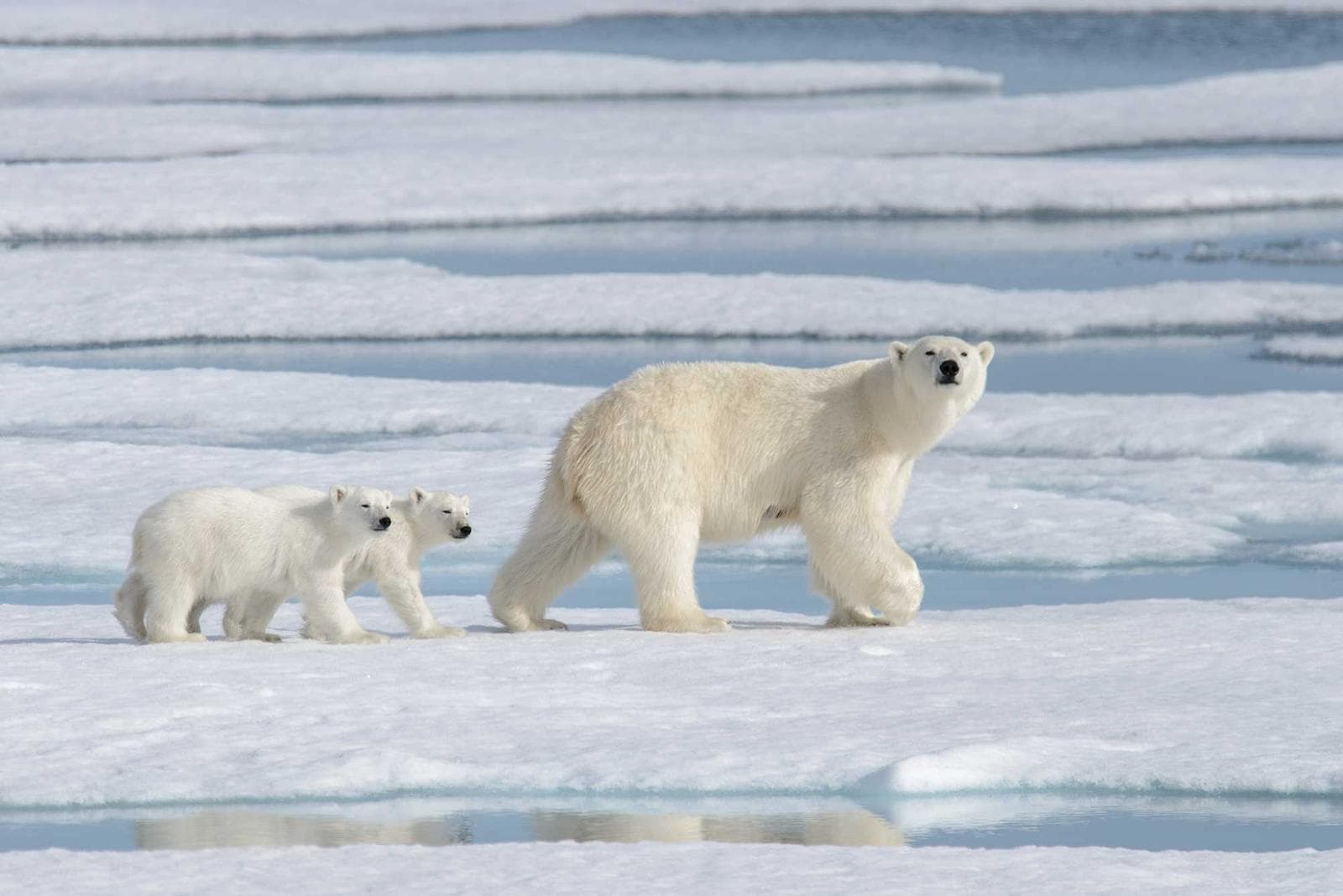
Polar Bear (Ursus maritimus)
The world's largest land carnivore and the undisputed icon of the Arctic. An estimated 3,000 polar bears live in Svalbard — more than the number of people living in Longyearbyen. They depend on sea ice to hunt seals and are most often seen along the ice edge and on glacier beaches. From the expedition ship's zodiac boats, you can photograph them at a safe distance (30–100 meters) without disturbing their natural behavior. A polar bear patrolling the ice edge in the midnight sun, with glaciers as a backdrop, is one of nature photography's most coveted subjects.
Photographing in Arctic Light
Svalbard's midnight sun provides unique, low light around the clock during summer — use it! The best images often occur during 'nighttime' (10 PM–4 AM) when the light is softest and most golden. Expose manually: snow and ice fool the light meter into underexposing. Overexpose +0.7 to +1.3 EV compared to the camera's suggestion. Use apertures f/5.6–f/8 for sharpness and a fast shutter speed (at least 1/1000 s) to compensate for zodiac boat movement. Polarizing filters reduce reflections in water and ice and give deeper blue skies.
Walrus — The Arctic's Armored Giants
Svalbard has a growing population of Atlantic walruses that, after decades of protection, now numbers several thousand animals. Walruses gather in large colonies on beach ridges — so-called 'haulouts' — where they rest, sunbathe, and socialize in tightly packed groups. Photography opportunities are excellent: zodiac boats can approach colonies carefully, and at certain locations, guided landings are permitted.
The best images capture walruses' social behavior: tusks crossing when males measure strength, mothers nursing calves, or a lone bull raising its head from the water beside the boat. Use 70–200 mm for group shots and 300–500 mm for portraits that emphasize the characteristic tusks and wrinkled skin folds.
Arctic Fox — Survivor of the Tundra
The Arctic fox (Vulpes lagopus) is Svalbard's smallest predator but perhaps the most photogenic. During summer, it wears a brown-gray coat that provides excellent camouflage against the tundra, while the winter coat is pure white. In Svalbard, Arctic foxes are often relatively fearless, especially near bird colonies where they search for eggs and chicks.
For best results: get down to the fox's eye level (lie on the ground if terrain permits). An Arctic fox in profile against a background of blooming tundra or glacier ice creates strong compositions. Foxes are most active during breeding season (June–July) when they're feeding their pups — then there's the opportunity to photograph the entire family at the den.
| Months | Season | Description | Rating |
|---|---|---|---|
| Jun | Early Summer | Ice begins to break up. Polar bears active along ice edge. Seabirds arrive. Midnight sun. | |
| Jul | Peak Season | Best polar bear chances. Walrus colonies active. Arctic fox with pups. 24h golden light. | |
| Aug | Late Summer | Glacier fronts calving. Blue and fin whales in fjords. Polar bears on land. | |
| Sep | Autumn | Autumn colors on tundra. Northern lights begin appearing. Darkness returns. Polar bears seek ice. | |
| Oct–May | Polar Night/Winter | Dark and extremely cold. No expeditions. Northern lights but inaccessible for photo tours. |
Equipment for Svalbard
Camera Bodies
Weather-sealed full-frame bodies are an absolute requirement — salt spray from zodiac boats, fog, and sudden snow squalls are everyday occurrences. Bring two camera bodies if possible; lens changes in a zodiac are risky. Extra batteries: cold drains them quickly.
Lenses
- As long as possible. At least 100–400 mm. Preferably 200–800 mm zoom — the most versatile choice for polar bears from zodiac
- 70–200 mm f/2.8 — for walrus colonies and environmental shots
- 24–70 mm — for landscape images and glacier fronts
- 1.4x Teleconverter — if you only have a 300 mm or shorter telephoto
Accessories
- Waterproof camera bag for zodiac trips (splash guards aren't enough)
- Microfiber cloths (salt spray on the front element is the biggest problem)
- Extra memory cards (you'll shoot 1,000+ images on a good day)
- Thin neoprene gloves that allow camera control in cold weather
Why Svalbard?
- Polar bears in the wild — One of the very few places where polar bears can be photographed in their natural Arctic environment, from a safe distance
- Midnight sun around the clock — Photograph in golden light at any time during summer, no 'missed' mornings
- Complete Arctic ecosystem — Polar bears, walruses, Arctic foxes, reindeer, whales, seabirds — all on the same trip
- Dramatic landscapes — Glaciers calving into the sea, fjords lined with jagged mountains, and ice fields stretching to the horizon
- Unique expedition experience — Traveling by expedition ship among pack ice and glaciers, with zodiac landings on uninhabited islands, is a life experience beyond the ordinary