
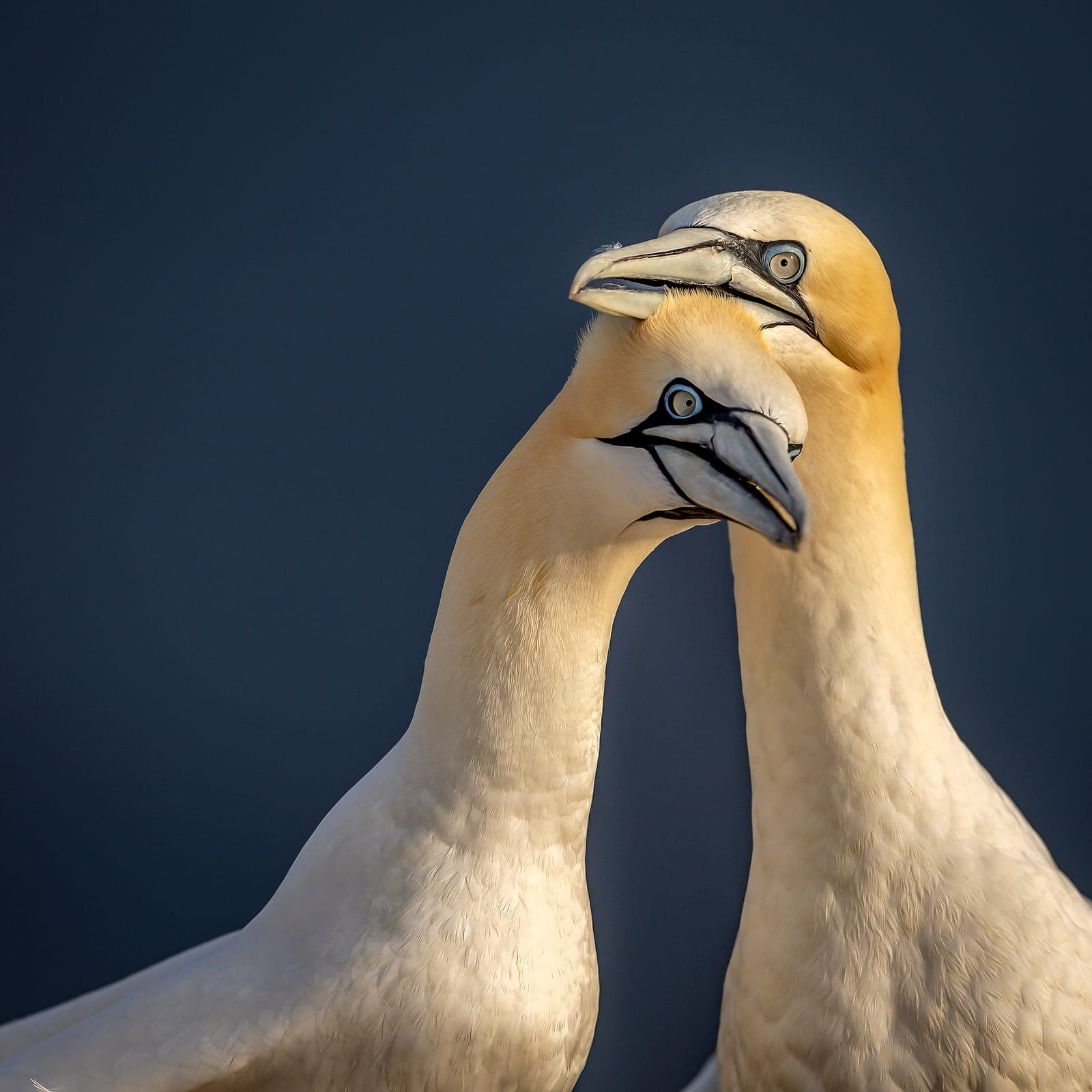
Gannets, seals and seabirds on Germany's most exciting island
Heligoland June 2027 additional departure
With guideFrode Wendelbo
Trip description
Seabirds and the gannet
The oceans make up most of the earth's surface, 71 percent to be more precise. And seabirds occur everywhere on earth. What the birds we call seabirds have in common is that they get their food from the sea. Ten years ago, people spoke of 346 seabird species, of which 200 are entirely pelagic species, which means that these live their lives entirely at sea - except when they breed.
Gannets thus spend most of their lives out at sea and only come ashore when it is time to raise young. We find them on both sides of the North Atlantic. When it is not breeding season, we often find them a little further south in the Atlantic - where the food supply is especially good.
Heligoland
Heligoland lies about 70 km off the German west coast and here we find the gannets unusually accessible. Sometimes they breed just half a metre from the barrier, and they do so completely unconcerned. Just like many other species of pelagic birds, the gannet is an outstanding glider out at sea, where it can cover long distances without expending any significant energy. But on land, when it is to land or take off, it is almost clumsy. And this gives us many opportunities for exciting and sometimes funny pictures.
Heligoland consists of several islands, of which the main island, Heligoland, is the most important. Heligoland is known for its fantastic cliffs, unique red sandstone formations and rich seabird populations and is a popular destination for nature lovers and tourists seeking beautiful nature. Historically, the island has been an important strategic and trading point, and it became part of the German Empire in 1890 after previously being leased from Great Britain. Today, Heligoland is best known for being an excellent place for birdwatching, for its maritime history and its dramatic landscape.
Not just gannets
On Heligoland there are a multitude of different bird species, many seabirds, gulls, larger gulls, terns but also other coastal and forest birds. The black-legged kittiwake and common guillemots are also among the breeding birds. However, the gannets, which breed on cliffs on the island's western and northern side, attract the most birdwatchers.
During migration periods you can see thousands of birds gather, which makes Heligoland a popular place for bird enthusiasts. We will come in May when some migratory birds will pass through and many will probably stop over.
The island has a tax-free status, which attracts many tourists especially from the mainland. Cheap spirits and beer and many shops with luxury goods. But that is down in the town district which lies just above sea level. Many pleasant pubs and restaurants are also there.
But we are above all interested in the gannets which are found higher up, on the 70-80 metre high cliff that makes up over half of the island.
Grey and harbour seals
We will also visit the neighbouring island of Düne, and here we find both grey and harbour seals and much other seabird life. Here a distance of at least 30 metres to the seals applies; if you come closer, a friendly guard will come and ask you to back off. So here we use a slightly longer telephoto lens. (When it comes to the gannets, the standard zoom and wide-angle can also come in handy.)
Brutus will give tips and small "workshops" if there are requests for it.
Images below © Frode Wendelbo and Brutus Östling respectively
Heligoland is a restful island to spend lovely holidays on. No private car traffic is allowed on the island.
Here, however, we find the gannets unusually accessible. Sometimes they breed just half a metre from the barrier, and they do so completely unconcerned.
The gannet is an outstanding flyer out at sea, where it can cover long distances without expending any significant energy. But on land, when it is to land or take off, it is almost clumsy. And this gives us many opportunities for exciting and sometimes funny pictures.
The gannets are best photographed in the evening, and if the sun shows itself there are good chances of gannets with the setting sun as background.
On one of the days we take the boat to the uninhabited neighbouring island of Düne. There we find both grey and harbour seals and much other seabird life.
Price
Clear pricing. Small groups. Focus on the images.
Early bird price
1,210 EUR
≈ $1,390 USD
per person
Normally 1,300 EUR
Save 90 EUR
Shared double room
Booking & peace of mind
Booking deposit
400 EUR
Travel guarantee included
Small group with personal guidance
Planned for the right light, place and pace
You’ll get confirmation and next steps by email.
Photo gallery
Itinerary
Day 1:
We gather at Brutus's home in Höör by 9.30 at the latest. There is plenty of parking space for cars here. Pick-up from Höör station for those who take the train. When everyone has arrived, we travel with Fokus's VW Caravelle bus (the extended model to take a lot of luggage) from Ågerup towards the port city of Büsum in Germany. At 17.00 we check in at our hotel. We are served evening meal at the hotel.
We have booked double rooms with toilet and shower. With early booking we may be able to arrange single rooms both here and for the three nights on Heligoland, preliminarily 3,600 SEK supplement for Heligoland and 850 SEK for single room in Büsum. Check with us! The last night, when we have returned to Brutus's farm, there is only a "dormitory". Some want to drive home by their own car directly during the night; those who sleep over are served breakfast at 7.30-8.00
If anyone has difficulty arriving at Brutus's farm at 9.45, up to four participants can arrive the evening before and sleep over at no extra cost. Yes, breakfast is served at 8.00.
Day 2:
We eat breakfast at the hotel at 7 and drive to the parking lot at the harbour in Büsum so that we are there at 8.30. We walk the approximately 100 metres to the ferry, which departs at 9.30. On Heligoland no cars are allowed; those who work in service occupations use electric cars, except ambulance and fire truck which run on fossil fuels.
The crossing takes about 2.5 hours so we arrive at about 12. When we go ashore we walk towards the village and find a place to eat lunch. After check-in in the village we make our way to the accommodation. No private car traffic is allowed on the island but there is transport of luggage and taxi. We recommend packing light and preferably a rolling suitcase as it is just over 1 km to walk from the ferry berth to the centre.
Lunch is paid for by each person individually; we find a good place in the village.
Simpler evening meal in the apartment as well as breakfast in the apartment is included.
The gannets are best photographed in the evening, and if the sun shows itself there are good chances of gannets with the setting sun as background.
Day 3:
Early morning for those who want. We go up on the cliffs and continue with the gannets. Lunch around 11.30
After lunch we take the boat over to the neighbouring island of Düne. There we find both grey and harbour seals and much other seabird life. Here a distance of at least 30 metres to the seals applies; if you come closer, a friendly guard will come and ask you to back off.
Back at the hostel we eat dinner and then it's off up on the cliffs again to the gannets.
Day 4:
This day we take as it comes; if anyone wants to go back to Düne, continue with the gannets or just wander around the island, then activities are free.
During daytime on one of the days Frode will have a small workshop on image editing on the computer.
Day 5:
Free activities again. We pack up from the accommodation and in the afternoon we make our way to the ferry again to travel back to the mainland.
During the evening and night we travel back to Höör. We are estimated to be home at Brutus's farm after midnight, located near Höör in Skåne.
Bedroom/dormitory is available at Brutus's so that you can rest before you make your way home in the morning. Some usually drive home directly during the night.
Day/morning 6:
Breakfast at 7-8 at Brutus's - for those who wish. Then journey home by car or a ride to the train.
As always the day program is preliminary; we change what we do also based on weather - and if something special should turn up.
Included in the price
- Travel to and from Höör
- Hotel in double room with toilet and shower near the ferry harbour in Germany
- Breakfast
- Ferry crossing
- Fokus purchases breakfast and evening meal for our two apartments, coffee, tea, sandwiches, toppings, yoghurt etc.
- We are served a good breakfast at which you can make a lunch packet to take with you, and in the evening we are treated to dinner
- Breakfast at Brutus's home the last morning
- We come back at midnight, shared accommodation the last night at Brutus's home, before everyone after breakfast makes their way home
- Review, guidance to good places on Heligoland
- Boat trip to the neighbouring island of Düne with grey and harbour seals and many birds
Not included
- Travel to and from the meeting point Höör
- Insurance and other things of a private nature
- Alcoholic beverages
- Dinner or lunch, but we find a restaurant to eat at together, or those who want eat on their own, any snacks, etc.
- Don't forget cancellation protection
Practical information
Date:
15 - 21 June 2027
6 days incl. travel/5 nights
Tour leader/photo leader:
Brutus Östling
Price (regular) 1300 EURO
Early booking price: 1210 EURO
(Applies to booking before 25 September 2026)
The registration fee is 4000 SEK
Number of participating photographers
Max 4/Minimum 4 participants
With a lower number of participants, a small supplement is added, see below.
The trip begins and ends:
at Brutus and Agneta's farm. Latest arrival time is 10.00
We come home with the bus at midnight. Sleeping place in a multi-bed room is included, and breakfast is served before the journey home by car or train.
Included in the price
Travel to and from Höör. The hotel is apartments with their own kitchen. Breakfast and evening meal included, Fokus purchases this. Ferry crossing round trip. All food at the hostel. We are served a good breakfast at which you can make a lunch packet to take with you, and in the evening we are treated to dinner. Bring a thermos and a box for sandwiches. At the hostel we stay in twin rooms with our own toilet and shower. Breakfast at Brutus's home the last morning. We come back at midnight, shared accommodation the last night at Brutus's home, before everyone after breakfast makes their way home.
Review, guidance to good places on Heligoland. Participation with advice and tips.
Boat trip to the neighbouring island of Düne with grey and harbour seals and many birds.
Accommodation
Very centrally located apartment up on the cliff ledge, so it is at most ten minutes' walk to the nearest breeding sites for the gannets. We stay in two very good apartments with two bedrooms in each. The apartments have a well-equipped kitchen; we can choose to shop together and/or eat lunch/dinner at any of the island's many restaurants/pizzeria. We have a favourite pizzeria! Breakfast all days is included, arranged by Fokus. There are also all types of shops on Heligoland, it is a large tourist resort.
The first night, when we have come to the port city, we have booked a double room with toilet and shower. Good breakfast. We come back to Brutus's farm in Skåne at midnight, simple accommodation the last night at Brutus's home. Generous breakfast before everyone makes their way home by car or is given a ride to the station in Höör/Hässleholm.
Not included in the price
Travel to and from the meeting point Höör. Insurance and other things of a private nature. Alcoholic beverages. Any snacks, etc.
Don't forget cancellation protection.
Single room
Supplement preliminarily 3,600 SEK on Heligoland, only subject to availability
The last night at Brutus's home before the journey home it is not possible to get a single room.
At the moment it looks like we can arrange a couple of single rooms in Büsum (extra cost 850 SEK),
Camera equipment
We get right up close to the gannets so everything from wide-angle to telephoto works there, good is a zoom 70-200 mm (preferably with converter) or a 100-400/500 mm is perfect. When we photograph incoming gannets a slightly longer focal length, preferably a zoom 100-400, 100-500, 200-600, 200-800, 400-800 mm or a fixed telephoto 400 mm with converter or 500/600 mm. Having only a zoom 200-600 mm or 400-800 mm becomes too long at some breeding sites.
Tamron's 35-150 mm or 28-200 mm are useful for landscapes and at the breeding sites. Or 24-70 plus 70-200/100-400 mm.
For other birds it will be a telephoto lens, from 400mm and up; that also suits the seals well where it is important to respect the distance of 30m.
If you have a wide-angle zoom and a telephoto zoom that suits excellently. A tripod can be good to have but not necessary; it depends a little on what type of telephoto lens you have or if you want to photograph when it gets dark.
If you have a fast long telephoto it is of course useful for beautiful portraits with nice bokeh background.
Clothing
In the evenings and during early morning it can get chilly with the proximity to the sea, but during the day it can get summer warmth. Rain-resistant clothing is of course good to have, possibly other items based on your own wishes. Comfortable shoes/boots as there will be quite a lot of walking. The cliff that we go up on is 80 m high; the nearest route from the hostel goes through sand dunes but good surface and then stairs up onto the cliff. In the village there is a lift for those who want to ride up a bit but it is a detour and costs about ten SEK.
A luggage bag or a wheeled cart is recommended for the walk from the ferry to the hotel.
A simple three-legged folding stool is available in outdoor stores and at Biltema. Very nice to sit on something low when photographing at the colony.
Accessibility/disability
Good walking paths, however stairs for part, but a lift is available to the cliff ledge where we stay. The apartments are probably the ones that are worse for accessibility for, for example, wheelchair. We walk on paved or gravel walking paths up to 1.5 km.
A lift from Heligoland's lower centre is available. Otherwise stairs or road respectively.
**Visa/Passport
**
Swedish citizens need a passport. In these times everyone must keep track of special rules, and we will of course check everything extra carefully and inform as much as we can.
*Payment terms
The payment terms deviate from our general travel terms.
The registration fee is 4000 SEK. The remainder is paid 30 days before the start of the trip. In case of cancellation later than 30 days before, neither the registration fee nor the final payment is refunded. Note thus that in case of cancellation later than one month before the start of the trip, the traveller is obliged to pay the full price of the trip.
If we become fewer than 5 participants we must charge 1,500 SEK extra per participant. The above applies regardless of which price has been booked.
Our Swedish price is calculated based on a euro rate of 10.90 SEK.
Insurance
In cooperation with Europeiska ERV we offer a complement to your home insurance and a cancellation protection. All so that you should be as safe as possible on your trip. Read more about what the insurance covers as well as
Good to know
High demand right now
Several departures are already fully booked or close to full. Book early to secure your preferred dates.
See current availability and prices in the booking form above