Sony FE 100–400mm F4.5 GM OSS – the perfect wildlife zoom?
At a glance
- Focal length
- 100–400mm (internal zoom)
- Maximum aperture
- Constant f/4.5
- Weight
- approx. 1,840 g
- Autofocus
- 4 XD linear motors
- Image stabilisation
- Optical (OSS)
- Mount
- Sony FE
Sony FE 100–400mm F4.5 GM OSS – an exceptionally flexible lens for wildlife
There are lenses that impress on the spec sheet and lenses that reveal their true value only out in the field. After using the new Sony FE 100–400mm F4.5 GM OSS during a trip in the Pantanal, this lens definitely belongs to the latter category.
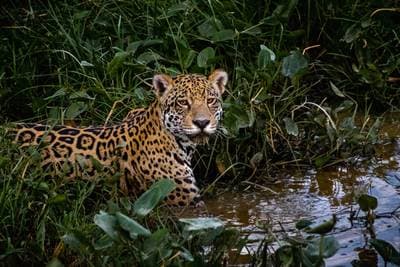
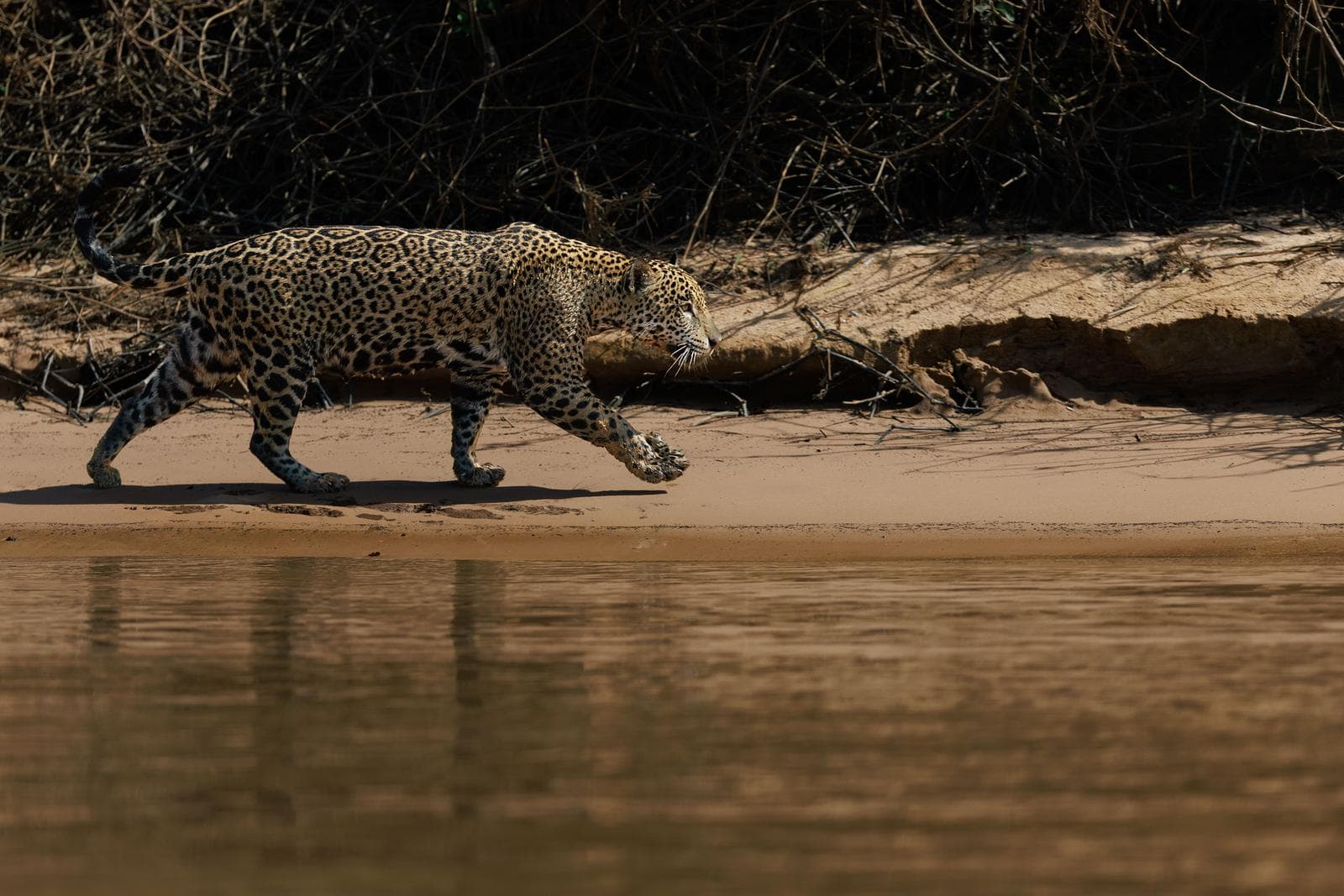
The Pantanal is an environment where distances, subjects and conditions change quickly. One moment you are photographing a jaguar at a relatively long distance along the riverbank, the next the animal comes considerably closer to the boat. Birds take off without warning, capybaras move between water and vegetation, and subjects often disappear as quickly as they appear.
In situations like these, flexibility is at least as important as maximum reach. And this is exactly where the Sony 100–400mm F4.5 GM OSS truly comes into its own.
The lens combines a very usable focal length range with a constant f/4.5, fast autofocus, high sharpness and a well-balanced construction that works surprisingly well for handheld photography.
It is not Sony's longest or brightest telephoto lens. But for many forms of wildlife photography it may be one of the most useful nature photography lenses Sony has built so far.
Tested under real-world conditions in the Pantanal
The lens was used on a high-resolution Sony A7R VI, mainly handheld from the smaller aluminium boats that are common in the Pantanal.
This is a far more demanding environment than a static test from a tripod. The boat moves constantly, while the photographer must be able to quickly change framing, follow animals through vegetation and react when subjects come closer or change direction.
Under these conditions the lens performed very well. The autofocus was fast and confidence-inspiring, image quality maintained a consistently high level, and the balance made the lens easier to work with than the weight on the spec sheet suggests.
Above all, the 100–400mm range proved to be almost ideal for jaguars.
A more useful zoom range than you might think
Within wildlife, there is often talk of the need for 600, 800 or even longer focal lengths. For small birds and animals at great distances, that is entirely reasonable. But when photographing larger mammals from a vehicle or boat, maximum reach is only part of the equation.
A jaguar might first be far away along the riverbank and, a few minutes later, come considerably closer. A capybara can be photographed as a tight portrait at 400mm, while the same situation shortly afterwards calls for 150mm to show the animal together with its surroundings.
At 100mm you can create environmental images, photograph larger groups and handle subjects that come close. At 400mm you can isolate the animal, create tight portraits and reach smaller or more distant subjects.
This means you can go from a broader, storytelling image to a concentrated portrait in a matter of seconds, without changing lens or camera body.
The real strength is therefore not that 100–400mm covers every conceivable situation. The strength is that the range covers a very large proportion of the situations that actually arise when photographing larger wildlife.
A longer lens gives more reach, but at the same time increases the risk of having too much focal length when the animal comes close. In practice, a 100–400mm can therefore give a higher probability of actually getting the shot.
Constant f/4.5 throughout the zoom range
The previous Sony 100–400mm GM had a maximum aperture that varied from f/4.5 to f/5.6. The new version keeps f/4.5 all the way to 400mm.
The difference from f/5.6 is about two-thirds of a stop. That is not a dramatic change, but in wildlife even a small light gain can be significant. It can mean a slightly faster shutter speed, lower ISO or better conditions for autofocus when the light begins to fade.
F/4.5 also contributes to a clearer separation between subject and background than slower telephoto zooms, especially at 300–400mm and shorter shooting distances.
The lens can be used wide open without any problems. We saw no practical need to stop down to achieve sufficient sharpness. Already at f/4.5 it delivers the level of detail rendering you would expect from a modern G Master lens.
That matters. An f/4.5 lens that in practice had to be used at f/5.6 or f/6.3 to perform optimally would have lost much of its point.
Sharpness at a high G Master level
The optical performance is very good throughout the zoom range. The images have high detail sharpness, good contrast and clear microcontrast, even at 400mm and wide open.
The latter is particularly important. Many telephoto zooms perform well in the middle of the zoom range but lose a little at the far end – precisely where the wildlife photographer often uses them.
With the Sony 100–400mm F4.5 GM OSS, 400mm does not feel like a compromise or a last resort. Fur, feathers and fine structures are rendered with high precision, even on the high-resolution sensor of the A7R VI.
Prime super telephotos can still deliver even higher microcontrast, softer backgrounds and more pronounced subject separation. A 400mm f/2.8 creates a different visual language. But it is also considerably larger, heavier, more expensive and less flexible.
The relevant comparison is therefore not solely about maximum image quality in a controlled situation. It is about how much quality you get in relation to weight, flexibility and the probability of having the right focal length when something happens.
Here the Sony 100–400mm is very strong.
Good subject separation – but not a 400mm f/2.8
At 300–400mm and at a relatively short shooting distance, the lens can create soft backgrounds and clear separation around the subject. The bokeh and the transition between sharpness and blur are generally pleasant.
With complex backgrounds featuring branches, foliage or strong highlights, the background can of course become busier than with a prime super telephoto with a larger aperture. That is a physical consequence of f/4.5, not an actual weakness in the design.
Anyone expecting the same three-dimensional separation as from a 400mm f/2.8 will not get it. But in relation to the lens's zoom range, size and usability, the result is very good.
The background, moreover, is not determined by aperture alone. The distance to the subject, the distance between subject and background, and the chosen focal length play at least as large a role. With the right positioning, 400mm and f/4.5 can give a very clean and appealing result.
Fast and reliable autofocus
Wildlife places considerably higher demands on autofocus than static test subjects. The lens must be able to follow animals through vegetation, handle rapid changes in distance and find its way back to the subject's eye after it has been momentarily obscured.
Sony uses four XD linear motors in the lens. According to the company, the autofocus is up to three times faster than in the predecessor, while performance is said to be improved by up to 50 percent. Manufacturer figures should always be considered in relation to how they were measured, but the experience in the field is that the focusing really is fast and direct.
Together with the A7R VI, the focusing worked very well. The lens did not feel like the limiting factor when animals moved along the riverbank or through more complicated environments.
The focusing is decisive rather than hesitant. When a situation lasts only a few seconds, that is an important difference. The photographer should be able to concentrate on the animal's behaviour, the light and the composition instead of wondering whether the lens will find focus.
Surprisingly good for handheld photography
The Sony 100–400mm F4.5 GM OSS weighs around 1,840 grams. So it is not a light lens in absolute terms, and definitely not a compact travel zoom.
At the same time, the weight figure does not tell the whole story.
The lens has internal zoom, which means that its length and centre of gravity do not change as you go from 100 to 400mm. This gives a consistent balance and makes a big difference during longer handheld sessions.
You avoid having to move your hand or adjust your grip when the focal length changes. From a boat, where both the photographer and the surface move, the predictable balance is particularly valuable.
The lens is still large and heavy enough to be noticeable after a long day, but it does not automatically require a tripod, monopod or gimbal. For many photographers, handheld photography is entirely realistic.
The image stabilisation also contributes. It cannot freeze an animal in motion, but it stabilises the viewfinder image and helps the photographer keep the focus point on the eye or compose a tight portrait at 400mm.
Internal zoom is more than a comfort feature
The internal zoom is not just a matter of premium feel. It offers several concrete advantages for wildlife photography.
The lens keeps the same length and balance throughout the zoom range. It also reduces the pumping effect that can draw dust or moisture into lenses with an extending zoom mechanism.
In the Pantanal, where humidity, dust and water spray are a natural part of the working environment, that is a relevant property.
The fixed format also makes the lens easier to handle in cramped boats. It does not grow forward when you zoom, reducing the risk of bumping into the gunwale, other equipment or a photographer beside you.
The construction makes the lens feel more like a professional prime telephoto with zoom capability than a traditional telephoto zoom.
A complete system from 100 to 800mm
During the trip, the 100–400mm was used together with the Sony 400–800mm on a second camera body. This gave immediate access to the entire range from 100 to 800mm without lens changes out in the boat.
It is a very effective combination.
The 100–400mm serves as the generalist for larger animals, environmental images, close encounters and rapidly changing situations. The 400–800mm is the specialist for birds, smaller subjects and animals at longer distances.
The lenses overlap at 400mm, which in practice is an advantage. You do not have to switch cameras at an exact cut-off point, but can choose the camera body based on the situation, the light and how quickly the subject is moving.
Two ready-mounted cameras also reduce the need for lens changes in a dusty, humid and cramped environment. It is faster, the sensors are better protected, and the risk of missing an unexpected situation is reduced.
When the light disappears
The downside of a system based on a 100–400mm f/4.5 and a 400–800mm f/6.3–8 is of course the brightness.
In good daylight this is rarely a major problem, especially with modern cameras that deliver good image quality at higher ISO. But early in the morning and late in the evening the light can fade quickly.
That is why the system was complemented with a 70–200mm f/2.8 for situations where the larger aperture was more important than reach.
The three lenses fill clear roles:
- 70–200mm f/2.8: low light, subjects close to the boat and maximum separation.
- 100–400mm f/4.5: flexible standard lens for the majority of the shooting.
- 400–800mm: birds, smaller subjects and longer distances.
This provides almost unbroken coverage from 70 to 800mm. You sacrifice some brightness compared to prime super telephotos, but gain a system that is considerably more flexible and still possible to travel with as hand luggage when the equipment is distributed thoughtfully.
Teleconverter or separate 400–800mm?
The Sony 100–400mm is compatible with both 1.4× and 2× teleconverters.
With the 1.4× converter the range becomes 140–560mm with a maximum aperture of around f/6.3. With the 2× you get 200–800mm and f/9.
For anyone who wants to travel with a single telephoto lens, the 1.4× converter in particular is an interesting solution. It provides extra reach without having to carry another large lens.
But a teleconverter always involves compromises. You lose light, some autofocus performance and potentially a little image quality. The converter must also be mounted or removed when the situation changes.
If you can carry a separate 400–800mm, the two-camera solution is faster and more flexible. For a lone photographer who prioritises low weight, however, the 100–400mm together with a 1.4× converter can be a very attractive travel system.
Ergonomics and minimum focusing distance
The lens has the controls you would expect from a professional G Master lens: focus limiter, several stabilisation modes, programmable focus buttons and controls that can be customised to the photographer's workflow.
The zoom ring is wide, smooth and easy to find without taking your eye from the viewfinder. Thanks to the internal zoom mechanism, the movement feels controlled and the camera's balance remains the same throughout the range.
The minimum focusing distance varies from about 0.64 to 1.5 metres depending on the focal length, with a maximum magnification of 0.25×. This does not make the lens a macro, but it works well for larger insects, reptiles, flowers and details in nature.
The wide zoom range also makes it useful for compressed landscapes and more abstract framing. The lens therefore does not have to function solely as a pure wildlife telephoto during a trip.
Size and travel-friendliness
With a weight of about 1,840 grams, a length of around 328mm and a 95mm filter thread, the lens is neither small nor discreet.
However, the size must be put in relation to what the lens offers: internal zoom, constant f/4.5, fast autofocus, optical stabilisation and very high image quality from 100 to 400mm.
Compared to a prime 400mm f/2.8 it is lighter and considerably more flexible. Compared to the predecessor, on the other hand, it is larger and heavier.
The new version is therefore not about maximum portability. It is about higher performance, better brightness at 400mm and a professional construction that is still realistic to use handheld.
Is 400mm enough for wildlife?
That depends entirely on which subjects you photograph.
For larger mammals, safari, boat photography and animals that can come relatively close, 100–400mm is a very useful range. In many situations it is more practical than a lens that starts at 200 or 400mm.
For small birds at long distances, on the other hand, 400mm is often too short, even on a high-resolution camera with good cropping potential.
An A7R camera makes 400mm more useful than it would have been on a body with lower resolution, but cropping does not replace real optical reach. Distance, atmospheric disturbances and the number of pixels on the subject still set clear limits.
The lens is therefore not the only telephoto a specialised bird photographer needs. For larger wildlife, however, it may well become the lens that is used the most.
The drawbacks
The most obvious drawback is the price. This is a professional G Master lens, and Sony charges accordingly.
The previous 100–400mm f/4.5–5.6 GM is still a good lens. It is lighter, smaller and considerably cheaper, not least on the used market. For anyone who does not need constant f/4.5, internal zoom or the latest autofocus performance, the predecessor can still be a rational choice.
The new lens is also heavy. The good balance makes it easier to use, but does not change the fact that 1.84 kilos must be packed, carried and lifted during long days.
Nor is 400mm enough for all subjects. For small birds or animals at great distances, you often need a teleconverter, heavier cropping or a separate longer lens.
F/4.5 is good for a zoom with this range, but cannot replace f/2.8 in really low light.
Who is the lens suited for?
The Sony 100–400mm F4.5 GM OSS is particularly well suited for:
- Wildlife photographers who mainly work with larger mammals.
- Safari and boat photography where the distance changes quickly.
- Photographers who want to combine environmental images and tight portraits without changing lens.
- Sports photographers who need fast autofocus and great flexibility.
- Users of high-resolution A7R bodies who want a good cropping margin.
- Professional users who prioritise internal zoom, operational reliability and consistent balance.
- Photographers who want to combine the lens with a 400–800mm or a teleconverter.
It is less of an obvious choice for anyone who almost exclusively photographs small birds at long distances. There, a 400–800mm, 200–600mm or prime super telephoto is still a more natural first choice.
Conclusion
The Sony FE 100–400mm F4.5 GM OSS is a very impressive wildlife lens.
It combines an exceptionally useful zoom range with high sharpness, fast autofocus, constant f/4.5 and a well-balanced construction that works considerably better handheld than the size and weight first suggest.
During the shooting in the Pantanal it became clear how valuable it is to be able to go from 100 to 400mm in a few seconds. The lens handles everything from animals in their environment to tight portraits and more distant subjects, without the photographer having to change lens or risk having too much focal length when the animal comes close.
Together with a 400–800mm on a second camera body, an almost unbroken system from 100 to 800mm is created. Complemented with a 70–200mm f/2.8 for low light, you get a very complete kit that is considerably more flexible than a collection of large prime super telephotos.
You sacrifice some maximum brightness and the extreme subject separation that a 400mm f/2.8 can provide. In return, you get a system that is easier to travel with, faster to work with and better suited to situations where the distance to the subject changes quickly.
The Sony 100–400mm F4.5 GM OSS is perhaps not the only wildlife lens you need. But it may well be the lens that solves the most real-world situations.
It is expensive, large and still relatively heavy. But it is also sharp, fast, well-balanced and exceptionally useful.
Sony has not built the lens with the longest reach or the largest aperture. They have built a lens that helps the photographer get more usable images in more situations.
For larger wildlife, safari and photography from a boat, it is hard to ask for much more.
Tested by

Michael Ahlén
Wildlife Photographer
Test period: July 2026
How we tested it: Tested during a trip in the Pantanal, mainly handheld from smaller boats, mounted on a Sony A7R VI.
The real strength is not that the range covers every conceivable situation – but that it covers a very large proportion of the situations that actually arise.
One of the most useful wildlife lenses Sony has built to date: an almost ideal range for larger wildlife, constant f/4.5, fast autofocus and high G Master sharpness in a package that works excellently handheld.
8/10
Very strong
- Image quality
- Exceptional
- Usability in the field
- Very high
- Travel-friendliness
- Good, but heavy
Our reviews and ratings are based on the needs of nature photographers.
Strengths
- Very good sharpness throughout the entire zoom range – even at 400mm and full aperture.
- 100–400mm covers a very large proportion of the situations that actually arise with larger wildlife.
- Fast and reliable autofocus that handles moving subjects, even handheld from a boat.
- Constant f/4.5 provides more light, better separation and better AF conditions than f/5.6 zooms.
- Internal zoom: constant length, stable balance and better protection against dust and moisture.
- Surprisingly easy to work with handheld during long sessions, thanks to the balance.
Limitations
- High price.
- About 1,840 grams – not a light lens and no compact travel zoom.
- Does not provide the same three-dimensional subject separation as a fixed 400mm f/2.8.
Who is it for?
For photographers who prioritise flexibility and the likelihood of actually getting the shot over maximum reach or brightness. Particularly strong from boat and safari vehicle – preferably paired with a longer telephoto such as a 400–800mm.
Best for: Safari and larger wildlife · Photography from boat and safari vehicle · Birds at medium range · Handheld wildlife photography
Field notes
Used mainly handheld from the smaller aluminium boats that are common in the Pantanal.
Mounted on a high-resolution Sony A7R VI, paired with a Sony 400–800mm on a second body – full coverage 100–800mm without changing lenses.
Full aperture f/4.5 was used throughout – no need to stop down for the sake of sharpness.
F/4.5 is not always enough early in the morning or late in the evening.
Enjoying what you read?
Subscribe to our newsletter for more photo tips and travel inspiration.