South Luangwa – Valley of the Leopard
30 September–7 October 2028
Chikunto Safari Lodge · South Luangwa National Park, Zambia
There are places in Africa where a leopard is a possibility that requires a large dose of luck.
And then there are places where the leopard is the very reason you travel there.
South Luangwa belongs to the latter category.
We scouted the park on site during the last week of September. What met us was exactly the landscape the trip is built for: late dry season, wildlife gathered around the river, and leopard that is not a coincidence – but a recurring part of the days.
This is not an ordinary safari trip.
It is a focused photo trip to one of Africa's most exciting leopard landscapes.
Why the beginning of October?
30 September–7 October 2028 has been chosen deliberately.
July to September is the pleasant period. Lower temperatures, easier days. In early October the valley is hotter, drier and denser. Worse for those who want to sit in the shade. Better for those who want to photograph.
As the dry season draws to a close, the animals are drawn toward the river and the last waterholes. The prey gathers, the predators follow, and the movements become easier to read. Not every day delivers a sequence. But the chance that something actually happens in front of the camera is higher than earlier in the season.
We have not chosen the date for the comfort. We have chosen it for the light and for where the animals are.
The window is short. November looks tempting on paper: fewer guests, lower prices, and if the rains are late the animals may still be standing by the river. The problem is that November is the month when the rains usually come. Sometimes at the end, sometimes already in the first week. When it comes, the animals leave the river, the grass shoots up within a week or so and the sightlines in the ebony disappear. The crossing over the dry riverbed into Nsefu can close within a few days. Chikunto and several of the Nsefu camps close in the middle of the month.
A November trip is a gamble that the rains will wait. Our week lies a month before that shift: the animals still pressed against the water, the forest open, the river drivable. It is the last reliable stretch of the dry season, not the week where the season may be over before you have landed.
Leopard as a clear main subject
This is a trip for you who want to give yourself a serious chance to work with leopard – not as a random bonus, but as the trip's clear main focus.
Wildlife can never be guaranteed. Animals move freely and nature follows its own rules. But South Luangwa is one of the few areas where leopard can genuinely be a realistic photographic focus over an entire week.
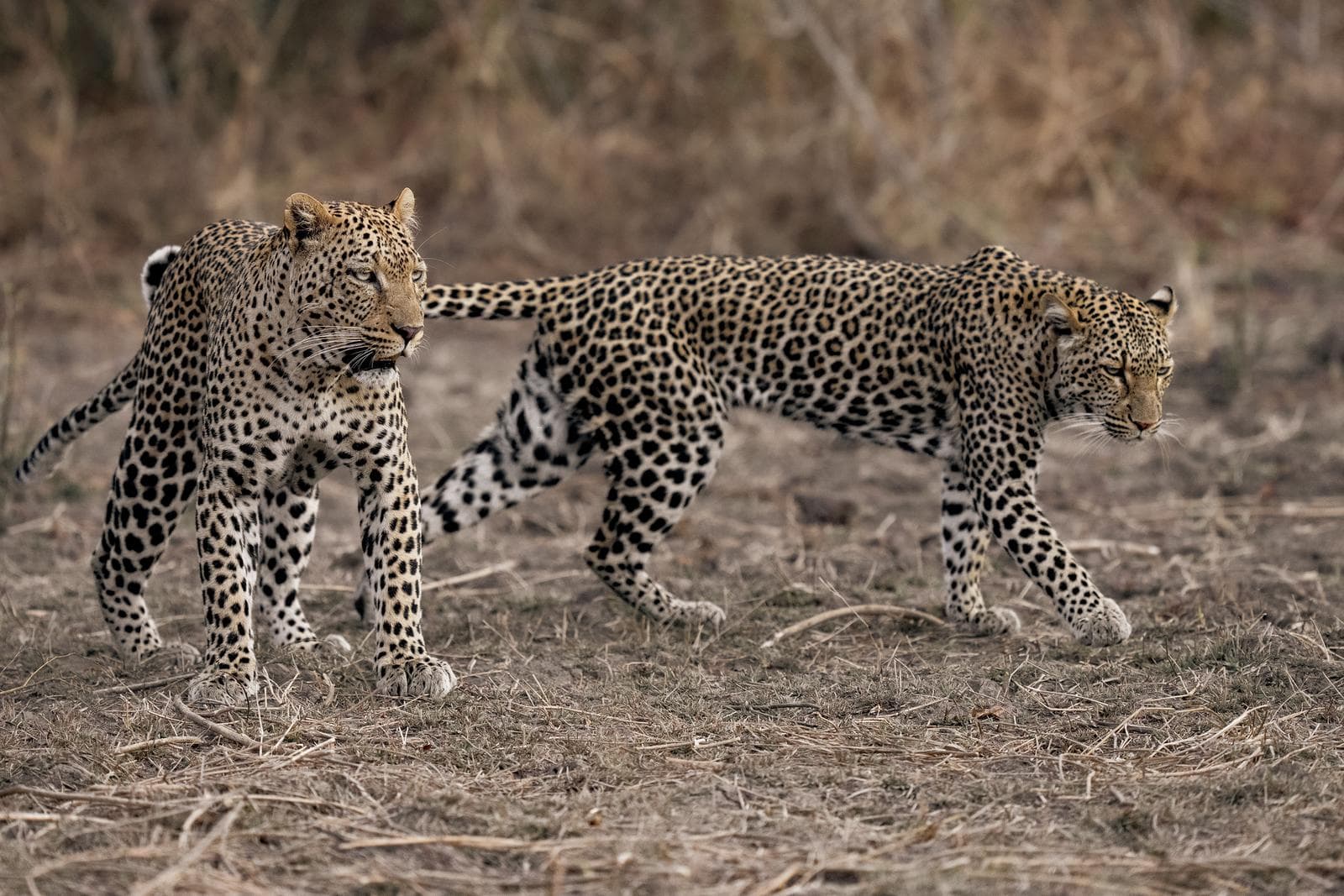
During our scouting at the end of September we saw eight different leopard individuals in six days. We had leopard sightings on almost every game drive. That is not a promise of the same outcome in 2028 – but it is the reason we dare to make leopard the core of the trip.
The goal is not just to see leopard. We want to give the sightings time and work methodically with:
- behaviours
- environmental shots
- portraits
- movement
- light and shadow
- leopard encounters during night drives
- interactions between predator and prey
- coherent image series
A leopard leaving the shade in the evening light.
An individual moving through the riverine forest.
An encounter in the dark.
That is the kind of opportunity the trip is created for.
A photogenic river landscape
South Luangwa is unusually photogenic.
Riverine forest, open floodplains, sandbanks, mopane and ebony groves lie close to one another. The light falls on the river bends and dusty plains in a way that makes the landscape graphic even before an animal steps into the frame.
For anyone who has been to Mana Pools, the recognition is often immediate: the same feeling of a large, meandering river that organises the whole scene, the same concentration of animals toward the water when it is at its driest – but with South Luangwa's own character, leopard density and the local species.
It is a park where the background is often as strong as the subject.
The Luangwa River is not just the park's backbone. It also carries one of Africa's largest populations of hippo – according to several surveys the largest in southern Africa. In late dry season the pods lie close together along bends, sandbanks and oxbow lagoons. Hippos then become both a photographic subject in their own right and a part of the landscape: breathing holes in still water, dusty evening walks up onto the banks, and the constant presence of the river in the images.
Chikunto – inside the park, in the right place
We stay the whole week at Chikunto Safari Lodge, a small premium camp inside South Luangwa National Park that we have hired exclusively just for our group.
The lodge lies directly by the Luangwa River, on Big Bend, about thirty minutes in from Mfuwe Gate.
The park opens at six o'clock. Those arriving from outside stand at the gate, sort out paperwork and only then drive in. We leave camp at quarter to six and are already in the middle of the park. The first light is often spent on an encounter near the lodge, or on the road north toward Nsefu, before the sun is high. By the time a vehicle from outside has made its way some distance into the park, the light is already gone.
Further north, inside Nsefu, we rarely meet other vehicles. No more than the occasional one. That gives time with the animals, and images without a row of vehicles in the background.
The camp is small: five luxury tents on raised decks facing the river. We book the whole property for our group. That means:
- no other guests in the camp
- private safari vehicles
- flexibility around times and activities
- the chance to stay when an encounter develops
- a cohesive group where the photography drives the setup
Even the drive in toward the lodge on the first day is a taste of the park. It is not transport. It is the first session.
A maximum of four photographers per vehicle
We plan the trip so there are never more than four photographers per safari vehicle.
That gives each photographer:
- a good working position
- a better chance to change sides
- room for camera equipment
- less risk of photographers blocking one another
- greater flexibility when an animal moves
Photography during the best hours of the day
The temperature can be high in the middle of the day – often around 30–35 degrees, and some days even warmer. The trip is therefore not built around photography in the harshest daylight.
We work mainly during the day's photographically strongest hours:
- early mornings
- late afternoons
- dusk
- darkness and night activity
In the middle of the day we normally return to camp for lunch, rest, image backup, battery charging and a review of the day's material. In this way we can work in a concentrated manner when the light, the temperature and the animals' activity are at their best.
More than leopard
The leopard is the main subject – but South Luangwa offers considerably more.
During the scouting we had, in addition to leopard, plenty of lion. Hyenas, including pups. Elephants, zebra, buffalo and giraffe – the landscape you expect from the valley, but in late dry season usually denser and more graphic.
Wild dogs are present in the park but are harder to find. During our trip we had one encounter with them – and what an encounter. That year the pack had a litter of a full 12 pups, which we did not however get to see in person; the pups made them more withdrawn than usual. That is typical of wild dog: when it happens it is often memorable. It is not something we can count on every day.
Here there is also the chance to work with:
- large elephant herds along the river
- hippo – one of Africa's densest populations, visible from the camp and along almost every stretch of river
- Nile crocodile
- antelope and puku
- birdlife
- river landscapes and dusty dry-season environments
The large elephant herds along the Luangwa can deliver some of the trip's strongest images – especially when the animals move through dust, cross the river or gather at the water in low light.
South Luangwa is moreover home to species that give the valley its own identity:
- Thornicroft's giraffe
- Crawshay's zebra
- Cookson's wildebeest
Species that set the area apart from many other safari areas in southern and eastern Africa.
A trip with several photographic layers
The early mornings are about soft light, tracks, movement and anticipation.
During the day the landscape changes. The light becomes harder, the heat builds and the animals seek shade.
In the afternoon we head out again as the temperature falls and the light begins to soften.
A group of lions leaving the shade.
A herd of giraffes crossing the river.
A leopard beginning to move ahead of the night.
When darkness falls, further opportunities open up for night activity, dramatic light and images that differ from classic safari photography.
The goal is to come home with more than a collection of isolated sightings.
We want to create a story about the place.
Who is the trip for?
This trip suits you if you:
- have a clear interest in wildlife photography
- want to work methodically with leopard and other predators
- appreciate private vehicles and small groups per vehicle
- want to give subjects and behaviours time
- are prepared for early mornings and long sessions in the field
- accept that nature governs both the pace and the results
You do not need to be a professional photographer – but you should have the ambition to develop your image-making and work seriously during the trip.
South Luangwa is not just another safari.
It is the Valley of the Leopard.
Trip facts
| |
|---|
| Destination | South Luangwa National Park, Zambia |
| Dates | 30 September–7 October 2028 |
| Number of nights | 7 nights |
| Season | Late dry season |
| Accommodation | Chikunto Safari Lodge – exclusively booked camp inside the national park, by the Luangwa River |
| Location | About 30 minutes in from Mfuwe Gate, prime location toward the northern sectors |
| Landscape | River valley in late dry season – photogenic, reminiscent of Mana Pools |
| Group size | Up to 8–12 participants |
| Photographers per vehicle | Maximum 4 |
| Photo focus | Leopard, predators, elephants, hippo and wild dog |
| Night game drives | Two as standard (more possible if the group wishes) |