
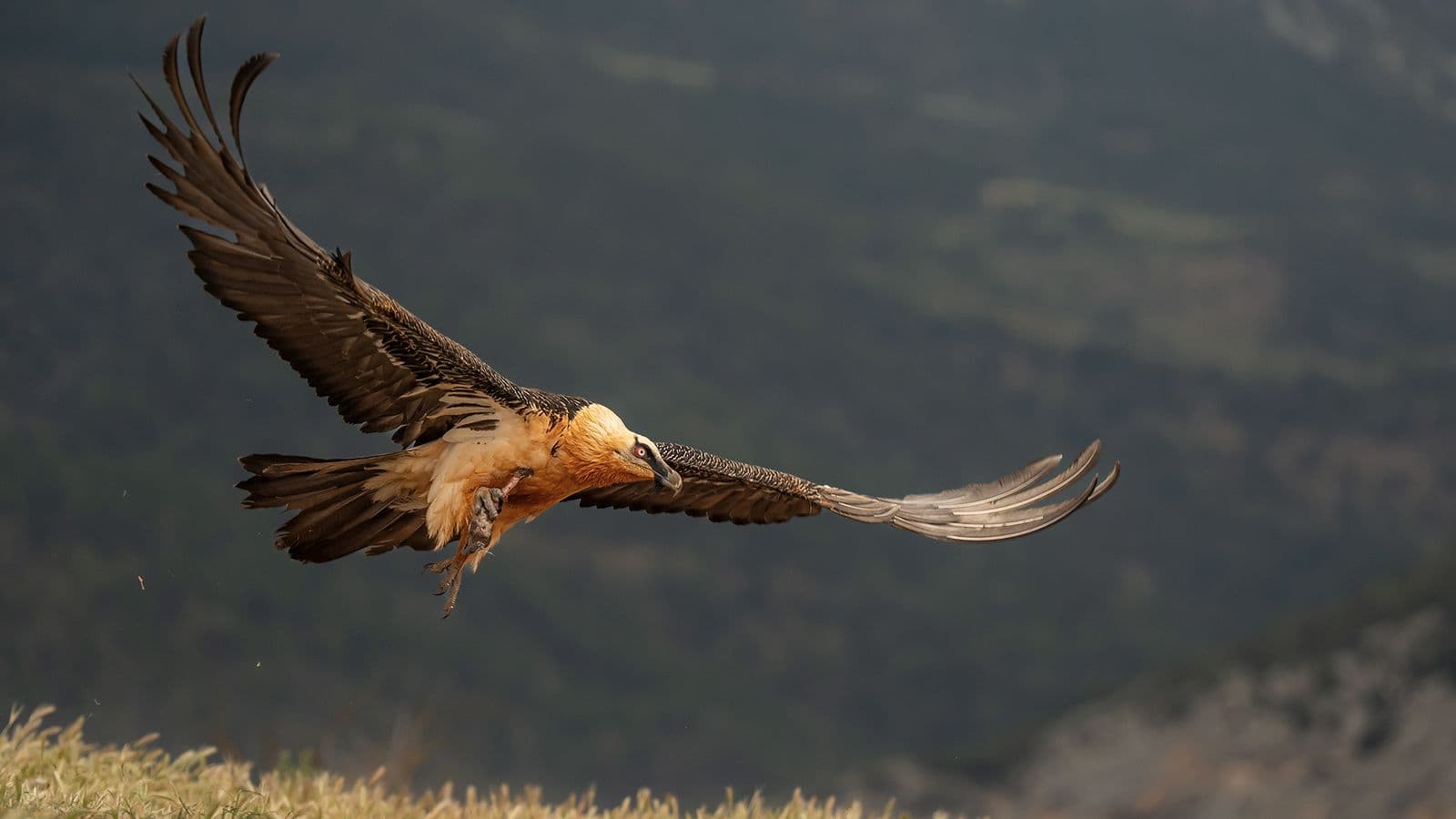
Bearded vultures, griffon vultures, black vultures, Egyptian vultures and displaying little bustards in Spain
Vulture Feast
Fokus Fotoresor
Overview
It's still chilly, at most a few degrees above freezing despite being in the second half of April. At just over two thousand meters altitude in the southern Pyrenees, the air only warms when the sun has been up for a few hours. A couple of Egyptian vultures have sailed by at a distance when suddenly a bearded vulture majestically glides over the valley below. It descends and lands gracefully on a rocky ledge. It almost looks like it's admiring the magnificent landscape. Another bearded vulture glides by and then descends for landing just behind the first bearded vulture's perch. A nesting site on the mountainside a bit further away must be the explanation.
There are 23 vulture species in the world. The four species that breed in Europe, in southern Europe to be precise, are bearded vulture, Egyptian vulture, griffon vulture and black vulture. We also find these species on other continents, although the bearded vultures in, for example, Ethiopia seem smaller than the bearded vultures that are resident in Spain. Perhaps the size difference is just a consequence of climate - in the Pyrenees as well as in the Alps and northern Greece, winters are colder than in Africa and animals tend to be larger where the climate is colder.
Vultures are primarily scavengers, although some people working on a vulture project in Spain told me there were a couple of Egyptian vulture individuals that had started killing animals. But then it was only sick and weak individuals or young animals. But generally, vultures keep nature clean. They reduce the spread of disease by eating all kinds of carcasses.
Worldwide, there are estimated to be fewer than five thousand griffon vultures, making the species one of the threatened vultures. The griffon vulture has been reintroduced to northern Spain in recent years, and now it can be spotted at one of the "vulture restaurants" that offer poison-free, veterinary-inspected food for threatened vulture species. This is something that has also benefited the griffon vulture and the severely threatened black vulture.
The griffon vulture is a tough bird that when it lands at the restaurants makes
even the countless Egyptian vultures become a bit cautious.
Eating carcasses is a dirty occupation. That's why most vulture species have more or less bare heads and necks. The bearded vulture differs in several ways from the other European vultures. To begin with, it's feathered on both neck and head, and it also has a small drooping mustache that hangs down from the beak.
But above all, it differs in terms of diet. The bearded vulture often comes to the "restaurants" when the other vultures have finished eating and the meat is gone. What remains are just the bone remnants, which are precisely the bearded vulture's specialty. It wants the nutritious bone marrow found inside the bones. To access the bone marrow, it has a special approach. If it doesn't swallow the bone parts whole - here one can rightly speak of "iron stomachs" - it can bang the bone pieces against stones or even more sophisticatedly: it takes the bone pieces up into the air and from 40-50 meters height then drops the bones so they shatter into small pieces against the rocks.
Many vultures breed colonially, but the bearded vulture is, just like the black vulture and griffon vulture, more solitary. A bearded vulture can glide up to seventy miles on a windy day. The bearded vulture pair's territory is extensive, and there's often at least a mile between nesting sites. The bearded vulture is not acutely threatened when looking at the whole world. In 2004, BirdLife International estimated the world population at between a couple of thousand and ten thousand birds.
But in Europe, the bearded vulture is one of the most threatened species after being quite common a couple of hundred years ago. When the EU banned farmers from leaving naturally deceased animals in nature a number of years ago, the vultures lost an important food source. The vulture restaurants became increasingly important.
Just like other vultures, both the black vulture and bearded vulture were severely affected by the veterinary use of diclofenac in India, where the use of this painkiller for livestock was banned twenty years ago. Now that local Spanish and Italian authorities have permitted diclofenac for use on livestock, the threat picture has become complicated regarding the already threatened bearded, black and griffon vultures in southern Europe.
In Sweden we have four lekking species: capercaillie, black grouse, great snipe and ruff. In southern Europe and especially in Spain we also find the little bustard, a species whose lekking sites are threatened. For many bird lovers, it has been a dream to photograph little bustard males, who make spectacular jumps during courtship. The lekking period is short, from early April and a week into May. And we travel here during the lekking period.
The little bustard male is significantly less shy during courtship than our capercaillie. Little bustard females are, however, even shyer than our capercaillie hens. So the actual mating occurs in the tall grass, well hidden from the curious.
The males' courtship display consists of flapping with the wings, followed by stamping on the ground that resembles a little flamenco dance which increases in tempo before the actual dance jump is performed.
When Brutus visited the fields outside Montgai in 2014, there was especially one little bustard male that differed from the other males on the open fields outside the village of Montgai in Catalonia in northeastern Spain. This male was at the display ground long before the sun rose, and long before the other males appeared. The wing flapping and stamping began in the night darkness when the only thing lighting up the fields was the occasional car headlights. He displayed until it was almost lunchtime. The other males rarely appeared before dawn.
Images except the hide image © Brutus Östling
Four hide days with photography of bearded vultures, griffon vultures, Egyptian vultures and black vultures, all European species.
Brutus has been down to the area around the Pyrenees a number of times since 2008. Photography takes place from hides with the best backgrounds and most reliable visits from the spectacular bearded vulture but also griffon vulture and black vulture.
The griffon vulture is being reintroduced in northern Spain, and one of the days we go to the hide with the most reliable visits from this tough bird.
The Egyptian vultures always come and they are many. The fights when the meat pieces are to be distributed provide lots of opportunities for action shots.
We photograph the little bustard from hides at the actual lek site. We go out before the first daylight.
The little bustard is the smallest of the bustards in the northern hemisphere, yet it's not a small bird, in length as large as a female pheasant.
It prefers to stay in undisturbed agricultural or meadow landscapes where the vegetation is high enough to provide protection during the display time.
In Spain, where the little bustard has its strongest foothold in Europe, the number of little bustard males is estimated to have decreased by 80-90 percent during the last thirty-year period. The population decline is largely due to
land areas that the species prefers (lands that perhaps were not considered usable) now being put to use for other purposes.
Price
Standard price
2,720 EUR
per person
Travel guarantee included
Small groups, personal experience
Planned for light, timing and photo opportunities
Photo gallery
Itinerary
The trip starts and ends at Barcelona airport
Some activities may change depending on where conditions are best.
Day 1, arrival day, April 16:
We arrive at Barcelona airport in the middle of the day, we drive in the Fokus bus to the village of Bonansa on a mountaintop where we check into the hotel and have dinner in the neighboring village. The drive takes just over 2.5 hours.
If the flight is very late, contact us when you land or earlier, during a stopover.
Day 2:
We sit in a larger vulture hide high up in the Pyrenees, with snow-covered mountain peaks in the background at more than 1700 meters altitude, a very special place where a multitude of vultures appear as soon as the farmer puts out the food. The vultures often land while he throws out the meat bones. First come the Egyptian vultures, a bit later the bearded vultures usually come, by then the Egyptian vultures have already done the preliminary work and the bones have been freed from much of the meat. The bearded vulture is a specialist, it wants the bone marrow. The black vultures may come before the bearded vultures, but they are small and look for meat scraps a bit to the side and in bushes while the Egyptian vultures fight over the large meat pieces. After the session we drive towards Cubells, where we check into a hotel where we will stay for the rest of the week.
Day 3 and day 4:
We sit in two different hides for bearded vultures but at the same location, a bit up in the mountains at the beginning of the Pyrenees. The photo location is chosen with the background in mind. See pictures. The background here differs from many other hides.
Toilet facilities are available, the hides have been modernized and are now two since Brutus was here among the first photographers in 2012-13 and they have become comfortable.
Day 5:
Half the day we sit in a vulture hide whose specialty is the griffon vulture, the fourth
European vulture species. The griffon vulture has been undergoing
reintroduction in Catalonia for the past few decades, and the attempts have been at least partially successful.
Naturally we also have Egyptian vultures and black vultures at this hide, as well as quite a few red and brown kites; after three days at bearded vulture hides we will probably be without bearded vultures this day.
The second half of the day we dedicate to displaying little bustards and little owls and perhaps some other raptors and smaller birds.
Day 6:
We head to the hides for little bustards and little owls respectively before sunrise. Little bustards often come before it gets light even though we never see them jump until later. Naturally no guarantee of jumping little bustards, this varies from year to year. In the afternoon we head to the same area but change hides. The hides are one-person and sometimes two-person hides.
Day 7:
We dedicate another morning to little bustards, bee-eaters or red and brown kites, and in the afternoon we change hides. Hopefully four, yes five different sessions will give us the images we hope for - and perhaps some surprises.
Day 8, April 23, 2026:
Departure from Barcelona airport, but at the earliest at lunchtime, so we have time to drive there.
Changes may occur depending on weather and other circumstances we cannot control. Changes are made in such cases to optimize conditions for good pictures.
Included in the price
- Accommodation in single rooms, everyone gets their own single room, we stay at the same hotel all week except the first night when we go to a hide high up in the Pyrenees, then we stay at the village hotel
Not included
- Round-trip flights to Barcelona, any
- tips, all food and drink, insurance and other personal items
- Cancellation protection
- We eat in connection with accommodation, this is paid by each person on site
- The Spanish countryside is characterized by low prices for food and drink
- For three-course dinners all seven days including a carafe of wine, beer or non-alcoholic drink, 2025 guests paid a total of between 150 and 165 €
Practical information
Dates
April 16-23, 2026
Regular price: 29,400 SEK
Book-early price until July 16: 27,900 SEK
(Registration fee 5,000 SEK, see below)*
Tour leader/photo guide
Brutus Östling
Number of participants
Min 5 / Max 5
Included in the price
Accommodation in single rooms, everyone gets their own single room, we stay at the same hotel all week except the first night when we go to a hide high up in the Pyrenees, then we stay at the village hotel.
Transports from the airport, to various hides and return to Barcelona airport
Six hide days and guidance from our tour leader as well as guides in Catalonia. Seven nights.
Accommodation
The accommodation is simple, cleaning and bed-making included. WiFi at the hotel, usually works in the rooms too. Guest-friendly staff with restaurant on the ground floor. The restaurant attracts guests from the surrounding towns, known for its good food.
Not included in the price
Round-trip flights to Barcelona, any tips, all food and drink, insurance and other personal items. Cancellation protection.
We eat in connection with accommodation, this is paid by each person on site. The Spanish countryside is characterized by low prices for food and drink. For three-course dinners all seven days including a carafe of wine, beer or non-alcoholic drink, 2025 guests paid a total of between 150 and 165 €.
Single room supplement
Single rooms included.
Trip start and end
The trip starts and ends at Barcelona airport, exact time will be announced later.
Camera equipment
Focal lengths and lenses, and now I'm assuming full frame: everything from 24mm for landscapes to longer. But 95% of the time you use from 100 to 500mm. Teleconverter for close-ups. Tripod and tripod head, and note that the tripod head must be detachable from the tripod.
Clothing
Warm jacket and sweaters are needed especially early in the morning when we're out, sometimes it can get really warm though, however: some days can be really chilly, especially applies to the day in the hide up at 1400 meters altitude.
Hide clothing
In the hides we should wear black or dark sweaters, if possible with long sleeves. Thin dark finger gloves are great, the light fingers are easily seen through the hide glass but it's not absolutely necessary.
Accessibility
The accommodation has some limitations regarding accessibility for those with functional mobility impairments. The areas we move in for photography may involve reduced accessibility with impaired mobility. Please call us and ask.
Visa/Passport
Swedish citizens don't need a visa but must have a passport. Passport required for flight check-in.
*Payment terms
The payment terms deviate from our general travel conditions. The registration fee is paid via invoice in connection with registration.
The registration fee is 5,000 SEK. This is not refunded upon cancellation.
By November 26, 2025, an additional 5,000 SEK is paid, and the remainder is paid 60 days before the trip begins. For later cancellation than November 26, 2025, Fokus retains both the booking fee and the 5,000 paid by November 26. If payment is late but cancellation occurs after November 26, Fokus has the right to demand the delayed payment on the then due amount.
For later cancellation than 60 days before the workshop, the full price is charged even if everything hasn't been paid on time.
Our price is calculated based on an exchange rate of 10.90 SEK (March 8, 2025).
Extra travel conditions for this trip:
Our price is calculated based on at least 5 participants and an exchange rate of 10.90 (March 8, 2025). The price is based on 2025 prices, no price increase has been announced, but if the hotel or hide renter raises prices, Fokus may charge a minor increase corresponding to this price increase, however at most 5% of the total price or 1,250 SEK. For higher increases, the traveler has the right to
Good to know
Plan early for the best light windows
Early decisions improve flight options, logistics, and access to peak photo opportunities.
See current availability and prices in the booking form above