
Africa's most exciting walking safari in Zimbabwe's magical light
Mana Pools
With guidesBrutus Östling, Catharina Ahlén
Trip description
Mana Pools in Zimbabwe is one of the few areas where you can photograph on foot among elephants, lions, hyenas, leopards, African wild dogs, hippos, baboons and large buffalo.
So we can lie down on the ground to get a better background.
We park the jeep at the free campsite down by the Zambezi River. We saw some lions in the area in the morning, and since it's been hot during the day, we assume the lions haven't been doing much other than what felines usually spend most of the day doing - sleeping. They should still be in the area. After a few hundred meters of walking, we spot them - a male lion in the company of a female. They are still resting. We walk in single file, and when we are about a hundred meters from the pair, we settle down. We wait for reactions. The male lion looks up but neither of the lions seems to mind our presence. Carefully we continue forward, first slightly bent over. Then we lie down and crawl forward. We stop constantly and check for signs that either of the lions would be uncomfortable with our presence.
After a while, the photography distance is perfect, the background is a wonderful forest environment with open clearings. We lie still on the ground, with our telephoto lenses aimed at the lion pair. After a while, the female gets up and starts moving around the male to get him going. It's clearly mating season, the male who has probably performed his work quite a few times in the past day is hard to wake and moderately interested. But after a while he gets up when the female starts moving away from there. The female has achieved her purpose, she goes back and lets her head caress the male and then entices him to come with her. The male no longer seems to be as hard to persuade...
Four pools, that's roughly how you can translate the name Mana Pools. The area got its name from the four permanent water bodies formed by river channels that have been cut off through millennia of sedimentation.
Mana Pools National Park in Zimbabwe has been on UNESCO's World Heritage List since 1984. The area is a real gem for both safari travelers and photographers. The national park itself covers approximately two thousand five hundred square kilometers, and the area was saved thirty years ago from the government's plans to create a dam and a large hydroelectric plant here, which would have resulted in large parts of the area being submerged.
Mana Pools is one of the few places in eastern and southern Africa that offers a truly classic safari. Here we walk freely in the area (but for longer distances we use the jeeps). Mana Pools is an area where photographers return year after year.
Encounters with the large elephants, wild dogs, lions and other animals occur on foot, in other words. This means a photographic freedom that is rare today.
Some of the largest elephants are known for standing on their hind legs to reach the vegetation of the taller trees, during the trip in October 2018 we also found a fifth one, a youngster of 15-20 years who also stands on his hind legs.
Furthermore, Mana Pools is an unusually beautiful place, it is mostly open ground where you can easily move around on foot but with large baobab trees (also called monkey bread trees or upside-down trees), fig trees, ebony and mahogany forest. The national park is also known for the special bluish light that is often created far away in the forest background. Overall, Mana Pools is an area where you are fascinated by the landscape, alongside more inaccessible areas with dense bushes, large open spaces and massive trees - and an abundance of wild animals.
Most of the year you encounter wild dogs, lions and other animals, but the large elephants and the African buffalo that you often see in herds come mainly during the dry period, from early August to the end of November. The rhinos have long been extinct here, unfortunately, but for a photographer this is outweighed by the incredible remaining wildlife.
Rich birdlife can be found at the various water bodies, and several species of bee-eaters nest along the banks of the Zambezi River. In early October, several water bodies usually dry up, fish and other food then become extremely accessible, birdlife can go completely crazy around these drying waters.
We mainly use the jeep to move longer distances. The actual photography, however, takes place 80-90% on foot. We run a smaller group.
We also usually photograph lions from ground level. When we move on foot, we have very knowledgeable guides with us. The guides are armed for our safety, but the two guides we usually work with have not needed to use these firearms in Mana Pools. (But that's why it's so important to do as the guides say.)
Just a couple of meters from our tent camp, we look straight down into the water of the Zambezi River. Even here it teems with crocodiles and hippos. A young hippo went for several years and slept between the tents to be protected from the lions in this way. Since he had been a regular guest, he had naturally been given a proper name: George (or Hippo). Now George is sexually mature and you only see him visit the camp sometimes.
Beyond the river that forms the border with Zambia, high mountains can be glimpsed, which provide a fantastic background if you manage to isolate an elephant or other animal against it.
We live in the middle of the national park, a few meters from the Zambezi River. All night you can hear the hippos down in the river, although you usually don't hear much because night sleep here is usually incredibly good.
We have no mandatory canoe trips, but from 2024 these will be operated. We don't book anything in advance, we must be sure that these can be carried out safely.
During the day it can happen that elephants bathe in mud right outside, the rest between safari tours thus means photography right at the camp for those who want and have the energy. And there's every reason to have the energy for it, there have been quite a few good pictures for my own part.
With reservation for typos/misspellings.
Also see a short video below from the latest trip, filmed with a simple DJI Action cam.
PARTICIPANT ON THE TRIP IN OCTOBER 2024:
"Mana Pools is perhaps for the slightly more adventurous traveler. Here you are offered the authentic safari feeling with the forest, lakes and Zambezi River as a delicious framing. Thanks to being allowed to leave the car together with a licensed guide, you get the opportunity for pictures that would otherwise have been very difficult to take. The accommodation, with the tent camp set up right next to the Zambezi River, is very good."
In the area there are packs of the rare and endangered African wild dog, we usually have great opportunities to photograph the wild dogs at relatively close range.
We are in Mana Pools - at the right time, in the right place, with the right conditions.
We have chosen mid-October as the optimal time for our trip to Mana Pools - one of Africa's most iconic places for photographing wild animals on foot. Our planning is adapted to the animals' natural behaviors, especially with regard to one of Africa's most charismatic predators: the wild dogs. At this time of year, the wild dogs have most certainly left their denning areas. Since they need access to water during the hot season, they seek their way down to the Zambezi River - in October we have often had them where our tent lodge, Mana River Camp, is located. For some years, the packs have lingered in their dens until early October. October therefore provides slightly more secure conditions for close contact and better photography opportunities.
We rent the entire Mana River Camp but have chosen to bring a maximum of 8 participants (in addition to Fokus's own guides). This means:
-
Better photo opportunities for each participant, both on foot and in the jeeps.
-
More space and freedom during walking safaris, which is a central part of the experience in Mana Pools.
Walking safaris require that we move as a compact unit, close to our guides. A smaller group provides good dynamics, experience and results - especially for serious photographers.
Despite paying for the entire lodge, we distribute the cost among fewer people. The price becomes slightly higher than if we ran a larger group.
The trip is for you who are a serious photographer who wants to come along to Mana Pools in a group with dedicated photographers.
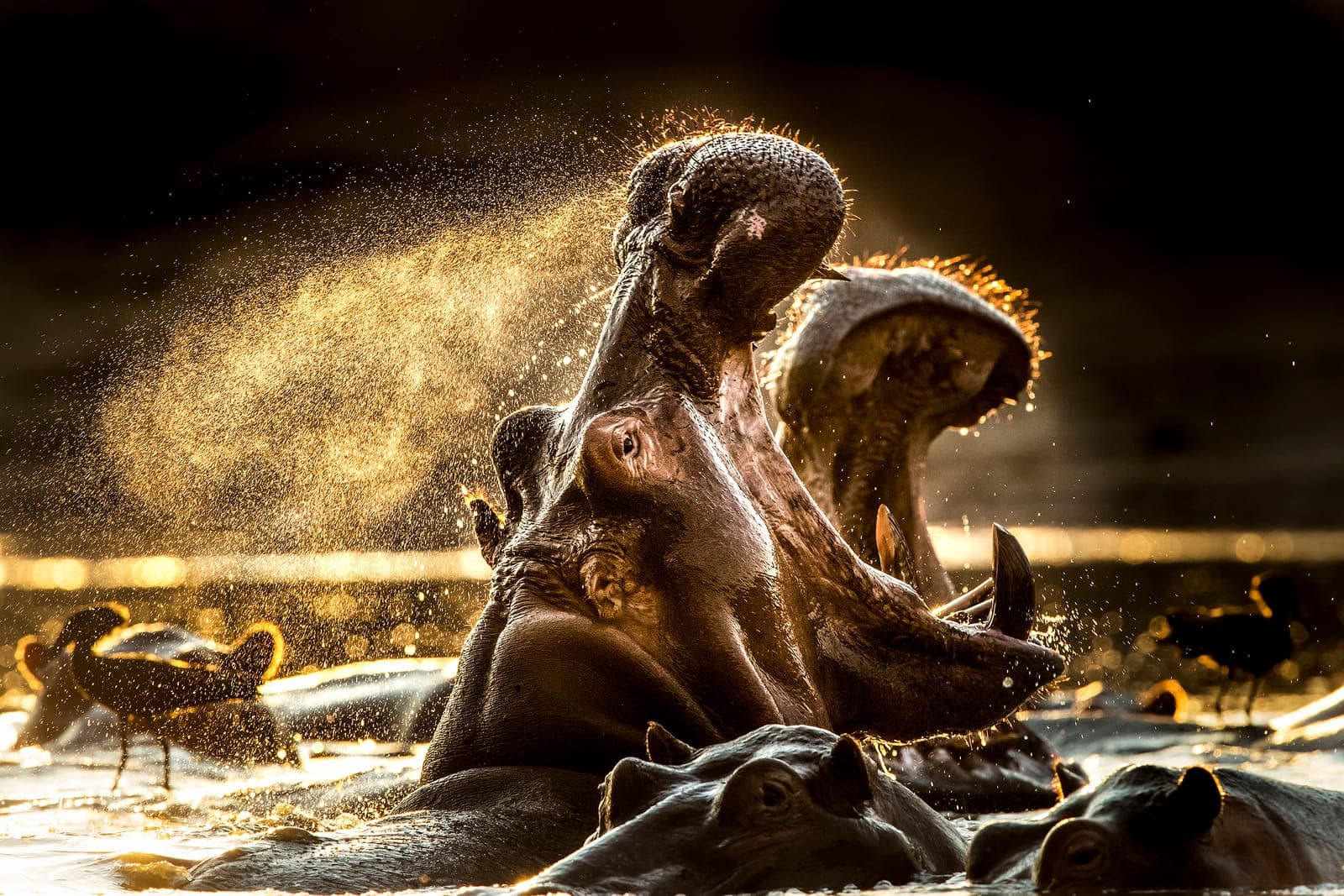
Hippos lying in mud, among green leaves or spraying water towards dusk. At a special place we take backlit shots in the warm late light just before sunset.
We are such a small group that everyone can come along to the wild dogs.
In addition to wild dogs, lions and many elephants at this time, Mana Pools offers rich birdlife at water bodies and several species of bee-eaters, including carmine bee-eaters, along the banks of the Zambezi River.
Guides
Brutus Östling
Travel Guide & Photographer
Brutus Östling, born in 1958 in Stockholm, worked for three decades as a book publisher before breaking through as a bird photographer with his debut book Mellan vingspetsarna (Between the Wingtips) (2005). Since then, he has p...
Read more about BrutusCatharina Ahlén
Photographer
Read more about CatharinaPrice
Clear pricing. Small groups. Focus on the images.
Early bird price
5,840 EUR
≈ $6,770 USD
per person
Normally 5,990 EUR
Save 150 EUR
Shared double room
Booking & peace of mind
Booking deposit
560 EUR
Travel guarantee included
Small group with personal guidance
Planned for the right light, place and pace
You’ll get confirmation and next steps by email.
Photo gallery
Itinerary
The journey begins and ends at Harare airport
Day 1
Flight from Harare airport to Mana Pools. At the airport in Harare you will be met by Brutus and/or Agneta, the flight captain will personally pick us up and take us with our luggage through security control and to the aircraft which is a smaller model. Arrival at Mana Pools so that we have time to go out on an afternoon safari after a brief briefing by Brutus and Dave or another local guide.
Day 2–7
During these days we will do safari tours both morning and afternoon. We drive by jeep for the longer distances, then we jump off the jeep and move on foot. Local guide with weapons always accompanies us when we then approach the animals on foot. It is important to listen to and follow the directives given by the local guide. We can often spread out, but the guides decide when and how. – In the middle of the day after brunch we take the opportunity to photograph near the lodge, often elephants come and mud bathe or drink from a water collection just outside the lodge. In the evenings we often get company from a hippo or elephant near the table we eat at. Power for charging computers, batteries etc. is supplied by a generator in the area that is turned on during the day and in the evening.
Day 8
Morning safari and after that breakfast/brunch. Then we are driven to the runway where we are picked up by an airplane that then flies us about an hour to Harare. When we have left the plane, everyone goes to waiting flights or continues in other ways on their own. We help to find B&B before and after the trip for those who wish.
BELOW PICTURES FROM THE TENT CAMP WHERE WE STAY, EACH ROOM/TENT HAS ITS OWN WC AND SHOWER AS WELL AS WASHBASIN IN ITS OWN SEPARATE SECTION, CLICK ON THE PICTURE FOR ENLARGEMENT
Included in the price
- Share in double room/tent, all meals included as well as non-alcoholic drinks, flight from Harare to Mana Pools and back
- Pickup from the runway in Mana Pools and drop-off for departure and other local transport in Mana Pools
- Safari tours mornings and afternoons with local guides,
- Entrance fees and other fees related to the national park,
Not included
- Round trip flight to Harare, Zimbabwe
- Extra baggage beyond what is allowed on the domestic flight Harare–Mana Pools
Zimbabwe
About Zimbabwe
Everything about wildlife photography in Mana Pools, Zimbabwe. UNESCO World Heritage site with unique elephants, wild dogs, lions and walking safaris.
Highlights
elephants, wild dogs, lions, hippos
Best time
Jul, Aug, Sep, Oct
Difficulty
Moderate
Practical information
Tour Leaders
Brutus Östling and Michael Ahlén.
Number of Participants: Minimum 7, maximum 8
Included in the Price
Share of double room/tent, all meals included as well as non-alcoholic beverages, flight from Harare to Mana Pools and back.
Pickup from the airstrip in Mana Pools and drop-off for departure and other local transportation in Mana Pools. Aircraft regulations apply.
Safari tours mornings and afternoons with local guides, entrance fees and other fees related to the national park, photo guidance from our photo guides, who are available for questions or advice.
Accommodation
We stay in a mid-standard tent camp. For a tent lodge, the standard is also high regarding food.
Not Included in the Price
Round-trip flights to Harare, Zimbabwe, tips, alcoholic beverages, insurance and other personal items.
Extra baggage beyond what is allowed on the domestic flight Harare–Mana Pools round trip.
Tips to local guides and camp service staff (one usually gives at least 12 USD per day to the guide, to service staff it varies more, but we usually recommend leaving the same amount). Tips are not mandatory but are much appreciated.
Single Room Supplement:
request price (own tent with WC/shower), probably around 12,500 SEK.
Trip Start and End
The trip starts and ends at Harare airport, exact time when the flight departs from Harare to Mana Pools will be announced later, see also next paragraph below.
About Flight Times
Departure time will probably be around 9 o'clock in the morning. Therefore, one should arrive in Harare the evening or day before. We inform about recommended good accommodation well in advance of the trip. The exact departure time home from Mana Pools is announced by the airline a few days before we are to head home. The return journey from Harare should therefore not be booked earlier than 5 PM on the final day.
Camera Equipment
Since we will be photographing many different types of subjects, everything from landscapes with and without animals to portraits of mammals and birds, it is suitable to bring everything from wide-angle lenses to telephoto lenses. On safari by jeep and on foot, lenses such as an 80/100-400mm zoom or 500mm are excellent. A 70-200mm zoom should be complemented with a longer focal length or 2x teleconverter. To increase focal length, one should use teleconverters in certain situations. A camera body with crop format apparently transforms 400mm to 600 or 640mm. With a full-format body, one should bring a 1.4x converter if the longest lens has a focal length of 400mm. If you have access to two camera bodies, it's good to bring both and have slightly different focal lengths on the bodies. This is to avoid having to change lenses if it's very dusty. Tripods are difficult to use in the jeeps, moreover almost all photography takes place on foot. A monopod is sometimes a good aid that also doesn't take up space in luggage. A simple lightweight tripod can, however, be good if opportunity arises for night photography.
Clothing
It is warm in October. Most of the time one wears shorts and shirt/sweater. Mornings may possibly be a little cool when traveling in the jeep so it's good to bring a thinner jacket. Cap or hat is good as protection against the sun. A pair of sturdier but airy sneakers is the best choice for feet.
Exclusivity, not too many in the group:
We rent the entire Mana River Camp – which has capacity for 12 guests – but we have chosen to bring a maximum of 8 participants (in addition to Fokus's own guides). More space and better walking safaris but only slightly higher cost.
Payment Terms
The payment terms deviate from our general travel terms. The registration fee of 6,000 is paid via invoice in connection with registration, the registration fee is not refunded upon cancellation. An additional 6,000 SEK is paid no later than the last day of December 2025. This amount is not refunded if cancellation occurs after this date. Invoice 3 of 18,000 is paid no later than 120 days before the trip's start. This amount is not refunded if cancellation occurs after this date. The remaining amount is paid no later than 70 days before the trip begins. If cancellation occurs later than 70 days before the trip begins, the traveler is obligated to pay the entire trip price, even if payment has not been made on time.
Extra Travel Terms for This Trip:
If the price for domestic flights due to circumstances we do not control is raised so that it costs more than 11,000 per booked traveler, we will in that case be forced to request a supplement, however at most 1,500 SEK per traveler. Our price is calculated based on the price set by the local airline for this year, 2025, and for the moment the domestic flight round trip runs at approximately 9,800 SEK per booked traveler and eight booked travelers. We do not expect any more than marginal price increases.
The trip's total price is calculated from a dollar exchange rate of 9.69 SEK (April 28, 2025).
If we are only 6 participants, the trip will still be conducted, but with a price supplement of 3,500 SEK per traveler. The domestic flight has limitations for baggage weight, we charter the entire plane, the last time we were in Mana Pools with a group, in October 2024, we could bring 20 kilos but we bought extra, and guests could then bring 28 kilos. Additional cost may be added for excessive baggage. Normally it is 18 kilos per traveler.
Accessibility
The accommodation has limitations regarding accessibility. The areas we move in for photography may involve reduced accessibility for those with reduced mobility.
Visa/Passport
Swedish citizens need a visa to Zimbabwe and the visa is issued upon entry against payment (approximately 25–50 USD). Your passport should be valid for at least 6 months after the return date from Zimbabwe, we recommend one year's time. If you are not a Swedish citizen, it is important that you find out which visa rules apply to you. A passport is required for flight check-in. Rules can change, and we keep the person booking informed as soon as we know.
Health
Contact your doctor to ask about vaccinations.
Group and Language
The tour leaders on our trips speak Swedish and English.
Information about central rights according to directive (EU) 2015/2302
From past travellers
What they brought home
After the trip, our guests share their photos and reflections. Here is a selection from photographers who have travelled with us before.
Photos from travellers' own cameras“Everything worked excellently on the trip, from flights and transport to the fantastic service we received on location from Justin and his staff. Accommodation on par with any fine hotel in glamping version with a fantastic view over the Zambezi River. Luxury-class food out in the bush that you can only expect at a fine restaurant. The guide Alf was top-notch in his knowledge both regarding the animals and angles for getting good photos. A wonderful experience to go out with the jeep and then follow e.g. Boswell or Fred (elephants) on foot for long distances, to finally witness how they stand on their hind legs to reach the food high up in the trees. Surreal feeling to be as close as 20-50 meters from wild dogs and lions without having proximity to a jeep but at the same time feeling safe with the guide. The entire trip was an experience and memory for life. Thank you Fokus fotoresor!”
Photos from past travellers
A selection of photos guests shared after the trip.
Good to know
High demand right now
Several departures are already fully booked or close to full. Book early to secure your preferred dates.
See current availability and prices in the booking form above