
Exclusive winter photography in Bence Máté's best hides
Hungary winter
With guideBrutus Östling
Trip description
Photography from winter hides here at Bence's is an exclusive opportunity. We now invite you to experience Bence Máté's fantastic hides during winter. Here you can truly capture images that stand out, and there's only room for six photographers plus Brutus, who has visited Bence in winter six or seven times before.
In February, it's usually winter even in Hungary, since the country is far from the sea, temperatures in the countryside can drop to minus 10 degrees or lower.
Pusztaszer is a village with just over a thousand inhabitants, located four to five miles from the Serbian border. From Budapest airport, it only takes 1.5 hours to drive.
The small village is probably best known today as the hometown of world-renowned photographer Bence Máté. Here the still young photographer grew up, and it's here he built his now world-famous hides for photographing bird life. Brutus was the very first foreign photographer to visit a then twenty-year-old Bence Máté, sixteen years ago. For a week they drove around the Hungarian countryside in an old Lada, bringing hide tents or photographing from the five hides that Bence had already built when he was barely twenty years old.
One day Bence showed off an old ruin where he said he planned to build a house to accommodate visiting photographers. Already the following year, the dilapidated ruin had been transformed into accommodation for five photographers, and since then photographers from around the world have come to photograph from Bence's now nearly thirty hides.
During the Covid period, the accommodation has expanded as well as the number of hides. Today there are twelve guest rooms, kitchen and dining area. Here you live comfortably and it's close to most hides.
The normal season has been from the end of April to mid-July.
But now Bence is offering some small groups to come during the winter season, the season when he himself has settled in a couple of the hides from time to time.
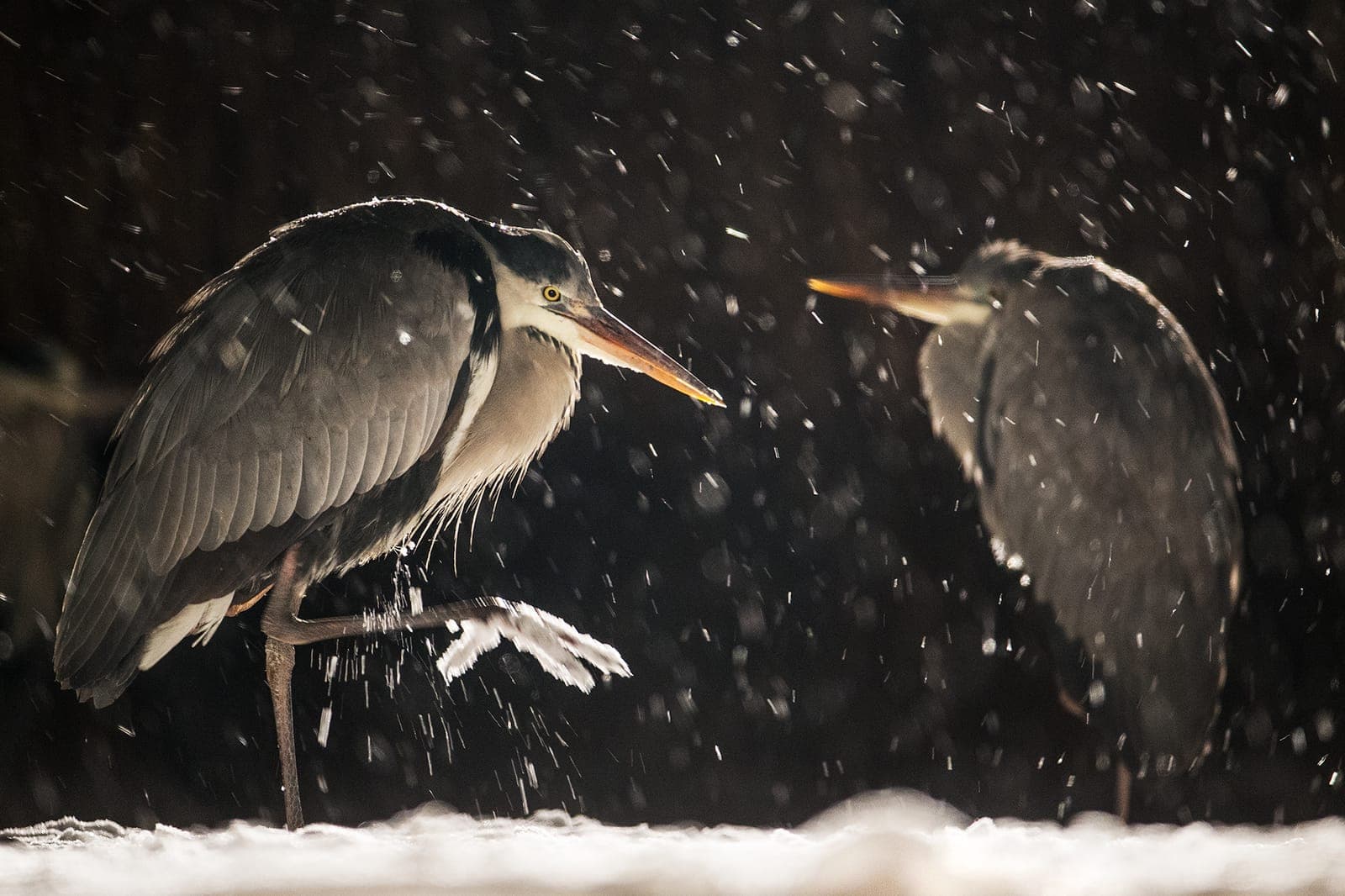
For it to work and be comfortable, we must be a small group. Photography is concentrated to a handful of top-class hides. But bird and animal life is all the more intense. Outside the hide called "The Theater" it's teeming with life, birds are fed fish during winter. Photography takes place around the clock, yes very much when night darkness has fallen. This is what creates the fantastic images with the help of spotlights that illuminate the ice and open water. Yes, you can sleep, after midnight activity usually decreases until dawn, then you can take the opportunity to get a few hours of rest. For sea eagles, bait is put out, and this contributes to their survival during a time when resources are scarce. Birds of prey come during the day, especially if it's cold. But the occasional fox also tends to sneak forward.
When night darkness falls, spotlights illuminate the area in front of the hide. We photograph backlit, and the photographic effects when herons shake fish with water splashing in all directions are striking. Some herons think "this place ain't big enough for both of us", and then there can be skirmishes with wings flailing in all directions whose contours are lit up by the light from behind. The splashing water is effectively backlit.
In recent years, cormorants also show up, but only as long as there's some daylight. It becomes chaotic when fish is available. When dusk falls and we get backlight from the spotlight, water splashes. Photographically absolutely fantastic.
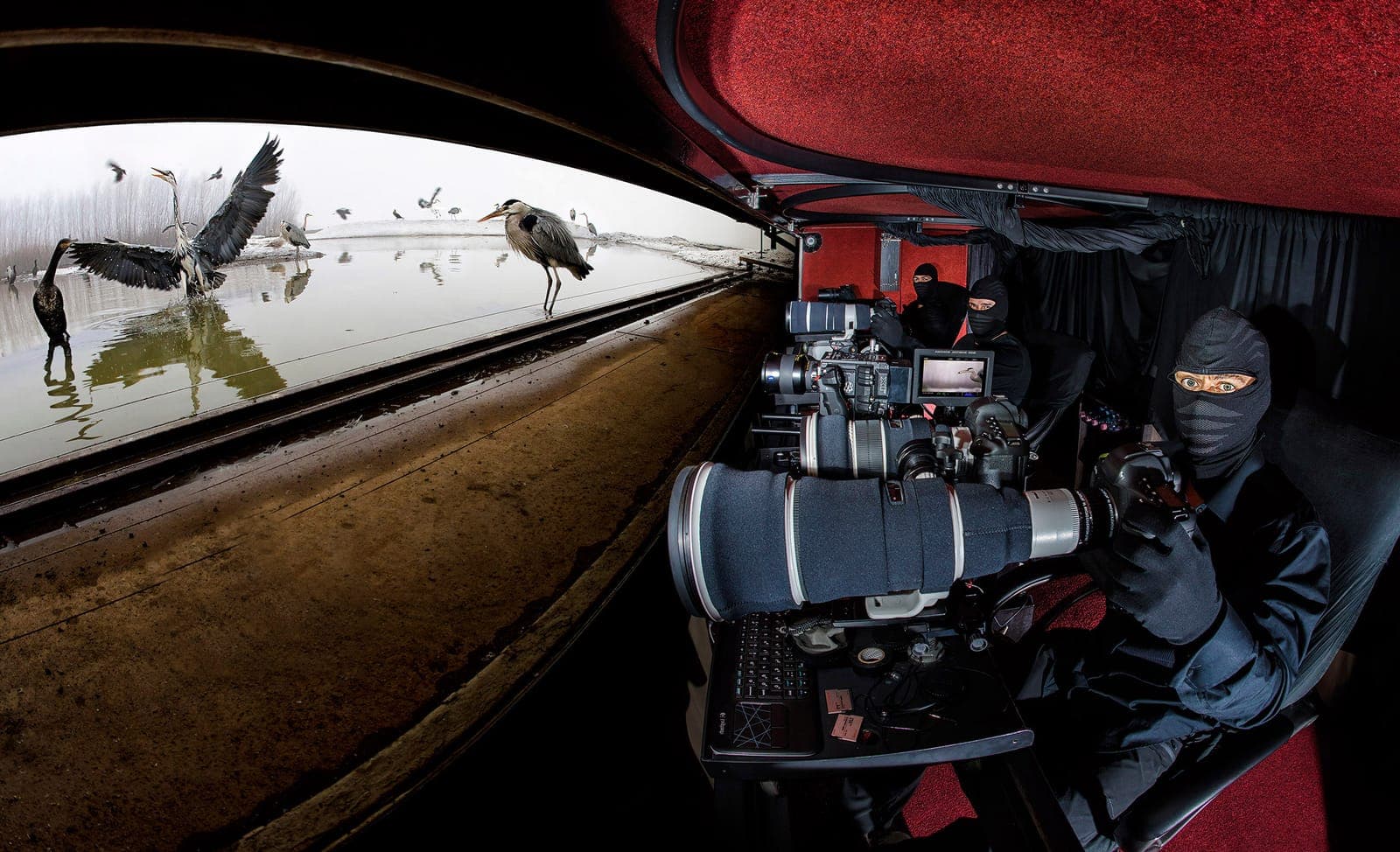
We have a schedule where we're assigned different hides each day and night. We spend three nights in "The Theater". Here there's a bedroom for each person and a kitchen. Everything comfortably arranged, here we have electricity, wifi and everything else we need. From the kitchen we go through a 14-meter long tunnel out to the actual hide with room for three photographers at a time. We sit in comfortable swivel chairs with a suspension device that allows us to use two cameras with different focal lengths simultaneously. We sit de facto below the water surface and thus photograph at ice level or water surface level. If you haven't visited The Theater before, you will be amazed.
From the hide "The Cinema" just 300 meters from this year's rebuilt "lodge" we also photograph during day and night. Here we concentrate at night on the otters that hang out outside the hide in the reed area. The lighting is above the hide but we can also create backlighting that gives water splashes and animal contours that fantastic glow. Besides otters, herons are active at night. Grey herons come and fish right in front of the hide.
Both The Cinema and The Theater are heated, as are the other hides by the way. We never need to freeze even if in extreme cases it can be 10-15° below zero outside. Should we unexpectedly fall asleep, a small alarm sounds if otters should appear. With everything in order, you just lean against the camera and start "shooting".
In The Theater and at The Cinema you also have wifi connection. Of course.
It's not just grey herons and great egrets that are active. At The Theater, great cormorants gather to get fish. There are enormous water cascades (photographically exciting) when birds try to get the fish and keep it for themselves.
At the hide called The Cinema, the water rail is a daily guest, but also the little bittern and common bittern pose in front of the hide in winter, no guarantees exist naturally for the latter. At night it's mainly otters that catch fish and splash water. Images of otters you can hardly get anywhere else.
New is the kingfisher hide. With constant lighting from two directions that allows us to capture the kingfisher diving into water and coming up with 1/4000th second and with ISO 4000 gives images we've only dreamed of. In winter this can mean 30 dives during a day's session (with lunch break 200 meters away, in the lodge). A four-thousandth second gives sharp images, if you want the water drops sharp you can go with 1/8000th second. And raise the ISO a bit too.
Another novelty is the rebuilding of the forest hide, where we photograph both during the day and in darkness in the evening. Daytime small birds, woodpeckers, nutcracker. And not least one or more buzzards. Good place for action between buzzards. Roe deer also pass with a beautiful forest background.
During the hours of darkness we use lighting, not least exciting are silhouette images of roe deer with lighting from behind and dark background. Photographically fantastically exciting, when the cold strikes at night. In the evening, pine martens can also appear.
Some nights we stay in The Theater, other days and nights we operate from Bence's "lodge", where all comforts are available. And it's never far to walk to the hides. At most it's 500 meters to walk.
Everyone stays in single rooms in the newly built modern lodge. The rooms have direct access to bathrooms in the room. Through the windows on the ground floor you can photograph herons right outside.
The winter season is for an exclusive group and with accommodation in the new lodge. New is that those who want can travel by minibus from Skåne to Bence's farm and back. Then no one needs to worry about carry-on baggage weights, on this trip you don't want to miss bringing everything you might want to use. You can park your own car at Brutus' farm.
NOTE! NEWLY POSTED. We reserve the right for typos that are obviously incorrect.
This week in January is about creative possibilities that are not otherwise given. This is an exclusive opportunity to experience Bence Máté's fantastic hides during winter. Here you can truly get images that stand out. This is for hardcore photographers.
There's only room on the trip for six photographers. Everyone gets a single room in the newly built modern lodge. Since we are so few and extra operational power is needed to maintain the hides during winter, this trip is about a thousand kronor higher in price than spring and summer trips.
Outside the hide called "The Theater" it's teeming with life, different types of herons, sea eagles, cormorants, also pygmy cormorants and many other species.
Take the images you've dreamed of in the new kingfisher hide!
Lighting both from the front and back guarantees a shutter speed of 1/4000 second with ISO 4000. And unlike with flashes, the specially constructed
lighting enables series of 20-30 images per second without interruption.
The Cinema is specially built for photographing otters, but it gets competition from herons at night too. During the day grey herons and great egrets are common guests, water rails are usually seen in front of the hide most days and just during winter bitterns can occasionally show up. Little bitterns are also among the guests.
Photography takes place around the clock in both The Theater and The Cinema, largely when night darkness has fallen.
It's spotlights that help create the fantastic backlit images in the dark.
We sleep and eat three of the days in the residence with kitchen and several bedrooms that's set up with a tunnel out to the fantastic hide in the wetland.
It's always 18 degrees in the two large hides, The Theater and The Cinema.
We photograph along ice
and water level, the lowest angle gives striking perspectives.
The winter period requires a lot of preparation of hides and more. This fact as well as that Bence and the guides can only accommodate a limited group means the trip costs a bit more than usual. We have however tried to keep the price down anyway. And it's our thought that it should be cheaper to book into our groups than to book directly yourself - which isn't always possible either.
Now you can add the trip from Sweden, meeting place at Brutus' home in Skåne or pickup/drop-off in Malmö/Hässleholm, for 1,900 kr.
Just the drive from the airport to the farm and then back normally costs 300 € each way. Taxi transport round trip is included in our price.
Price
Clear pricing. Small groups. Focus on the images.
Early bird price
3,370 EUR
≈ $3,910 USD
per person
Normally 3,440 EUR
Save 70 EUR
Shared double room
Booking & peace of mind
Booking deposit
750 EUR
Travel guarantee included
Small group with personal guidance
Planned for the right light, place and pace
You’ll get confirmation and next steps by email.
Photo gallery
Itinerary
The trip begins and ends at the airport just outside Budapest.
Day 1
Arrival at lunchtime, we are picked up by minibus/taxi at the airport at 1 PM and checked into our guest rooms, eat something and then head straight to the hides for photography. The exact latest arrival time will be announced in October, do not book flights before we confirm the meeting time. If arriving one day earlier, accommodation at Ibis Hotel is recommended, which is affordable with good breakfast and within easy walking distance from the terminal and pickup location
Days 2–7
During these days we will split up, three people to "The Theater" where we also sleep a couple of nights, the other three stay at "The Farm" but utilize the other hides, primarily "The Cinema". Like "The Theater", we sit there in comfortable armchairs, should we fall asleep there is an alarm that wakes us if one or more otters show up. Both The Cinema and The Theater have wifi connection.
We photograph from a forest hide with water feature, involving both roe deer and woodpeckers and overwintering small birds. We also dedicate time to the kingfisher in a hide. When we're not in The Theater, everyone has quite large opportunities to organize their own activities. Regarding The Cinema, we naturally need to coordinate with the other two, we can leave The Cinema early, but there can't be too much running around.
One cooked meal per day is served during winter. We fix breakfast and lunch ourselves, two full refrigerators with platters of cheese, meat and vegetables guarantee there's always something to choose from. Soup is available to heat up.
Day 8
After hide sitting we leave Bence's farm at around 12 PM. We naturally get something to eat first. No flights should be booked before 5:30 PM. If booking other times, taxi transport can be arranged, additional cost approximately €100 per direction per person.
Included in the price
- Transport from Budapest airport and back
- Private room in newly built lodge, all meals included as well as non-alcoholic drinks
- All hide activities, all guiding and local transport included
Not included
- Flights to Budapest
- Insurance and other private matters
- Cancellation protection
Hungary
About Hungary
Photograph bee-eaters, rollers and raptors from specially built hides in the Hungarian puszta.
Highlights
bee-eaters, European roller, raptors, hides
Best time
Mar, Apr, May, Sep, Oct
Difficulty
Easy
Practical information
Tour leader
Brutus Östling
Number of participants
Min 6 / Max 6
Included in the price
Transport from Budapest airport and back. Private room in newly built lodge, all meals included as well as non-alcoholic drinks.
All hide activities, all guiding and local transport included.
NOTE! Include transport by minibus to/from Brutus's farm or Malmö/Helsingborg/Hässleholm - Bence's farm, round trip. Avoid hassle with baggage weights on the plane. Additional cost 1,900 SEK.
Accommodation
We stay in a lodge, also called "the farm", the accommodation is of middle-class character but luxurious for Hungarian countryside.
Not included in the price
Flights to/from Budapest. Insurance and other private matters. Don't forget cancellation protection.
Single room included
No surcharge.
Camera equipment
Since we will primarily be photographing birds and animals, telephoto lenses or telephoto zooms are mainly required. A zoom of 80/100-400 mm or 100-500/600 mm are excellent. A 70-200 mm zoom is good for "The Cinema" when photographing otters. To increase focal length, teleconverters can be used in certain situations. A camera body with crop format seemingly transforms 400 mm to 600 or 640 mm. With a full-frame body, one should bring a 1.4x converter if the longest lens has a focal length of 400 mm. Since there is much night photography and action, it's always good if some telephoto lens has good light transmission, f/2.8 or f/4 for example. If you have access to two camera bodies, it's good to bring both and have slightly different focal lengths on the bodies. This is to avoid having to change lenses if it gets very dusty. In all hides there are suspension devices or tripods for the cameras. In both The Theater and The Cinema you can hang up two camera bodies with lenses simultaneously.
A normal zoom equivalent to 24 mm on the wide-angle side is good to have, as sometimes we or rather the birds get close. In the hides we are "invisible". A wide-angle zoom is not entirely necessary, but good if we get the opportunity to photograph landscapes or night sky. A tripod will not be needed, except for photographing landscapes or night sky outside the hides.
Clothing
The temperature varies like in Sweden from plus a few degrees to minus 10, sometimes it can get to minus 20°C. In some places it can be good to have proper boots. Inside the hides, as well as in kitchen and guest rooms, shoes are forbidden, but you can bring some warming indoor shoes/slippers. Slipper-like footwear is available.
Hide clothing
In the hides we should wear black or dark shirts, preferably with long sleeves. This makes us more invisible to the birds, especially sensitive with birds of prey. Thin dark finger gloves are always good, light fingers are easily seen through the hide glass. Thin so-called balaclava can be used but is not at all necessary.
Accessibility
The hides have limitations regarding accessibility. But much can be solved. Get in touch and ask.
Visa/Passport
Swedish citizens need a passport. Passport is required for flight check-in. In these times everyone must keep track of special rules, and we will naturally check everything extra carefully and inform as much as we can.
*Payment terms
Payment terms differ from our general travel conditions.
The registration fee is 8,000 SEK. Registration fee is never refunded upon cancellation. By December 15, 2025 at the latest, an additional 5,000 SEK is paid. Upon cancellation after December 15, 2025, neither this amount nor the registration fee is refunded. Should the 5,000 not have been paid on time, Fokus has the right to demand this payment if cancellation occurs after this date. By September 20, 2026 at the latest, the remainder is paid.
Note: If cancellation occurs after September 20, 2026, nothing of the trip price is refunded. This applies even if payment has not been made according to the schedule above. Fokus has the right to claim the entire trip amount even if payments have not been made on time.
We encourage everyone to have cancellation protection, this protects against illness and similar.
The price is calculated based on a euro rate of 10.95 SEK (March 8, 2024).
Since Nets that sends payment links for cards currently doesn't work as it used to, we have temporarily removed the possibility to pay with debit and credit cards. It's at most one traveler in a hundred who has used cards but we regret that this no longer works. See further reporting about these problems in news media.
Insurance
In collaboration with European ERV we offer a complement to your home insurance and cancellation protection. All to make you as secure as possible on your trip. [Read more about what the insurance covers and
Related articles
Good to know
High demand right now
Several departures are already fully booked or close to full. Book early to secure your preferred dates.
See current availability and prices in the booking form above